Thanks to my lovely colleague Aiga, this year we were able to take on a new challenge - not to drive along the coastline, as we had done many years before, but to simply walk part of it. Moreover, it was not only a significant challenge for desk-dwellers' muscles, but also a discovery of the nature and history of Latvia's western coast.
Whatever happened to the times when one went to Saaremaa on a school-rented bus and stayed in a campsite?! Everyone was obediently taken around the traditional most popular spots of Muhu Island and Saaremaa - the meteorite crater, wooden windmills, Kuressaare Fortress, the rocky cliff. Incidentally, it was right from the Panga cliff that some good years back I brought home a stone with a pasty's soul (I have this quirk of looking for special stones).
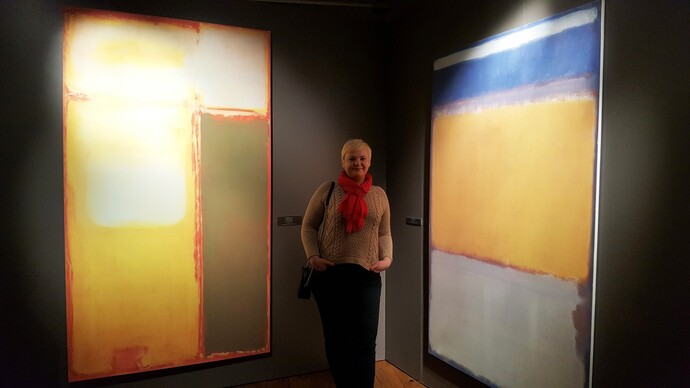
We tried to lighten the grey and subdued mood of the rainy Easter holidays by going to Daugavpils and enjoying the large, colour-rich works of Mark Rothko, which art critics and the artist himself compared to the walls of a temple or portals to another parallel reality.
This will be the last of five articles about the trip to the Netherlands, whose positive impressions are still vivid in the memory. This time the story is about a small but - in the Netherlands and neighbouring countries - popular resort town called Zandvoort (Zandvoort aan Zee), to which we went by bus from Haarlem to enjoy the world and swim in the North Sea.
One morning we got up quite early, made do with Starbucks coffee at the railway station instead of breakfast (seemingly the only place where a decent large size is available - everywhere else in Amsterdam and beyond, they served truly tiny cups), and boarded a train from Haarlem to Rotterdam, which by all accounts is radically different from Amsterdam and Haarlem itself. And so it proved.
A distinctly Dutch city of snobs and wealthy people, one of the most expensive in the country. But very well-kept and refined - a city for enjoying life, with countless shops, cafés, and art salons.
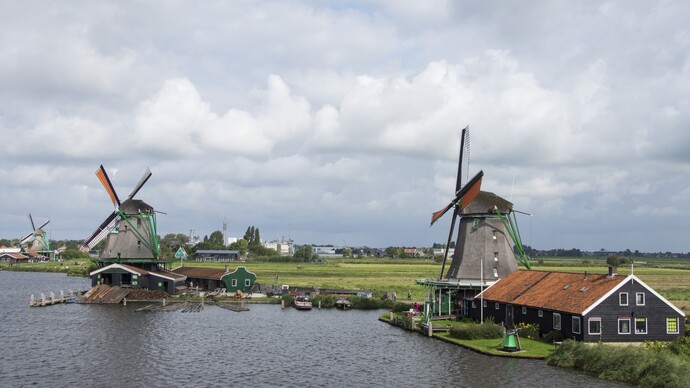
A historic village reflecting Dutch everyday life of the 18th–19th centuries. Essentially an open-air museum with several still-operational windmills, traditional residential houses that have largely been converted into shops, cafés, souvenir stalls, mini museums, and craft workshops. And a picturesque view of the waterway, against which one simply cannot resist taking selfies.
We had been planning this trip to the Netherlands since early summer, so we were well prepared, having researched transport and accommodation options. This definitely helped save both time and money, as the country - and especially the cities of Amsterdam and Haarlem - is quite expensive. I am happy to share impressions and useful tips for those planning to go "on their own."
The thermometer had almost climbed to +30 degrees, and visiting a museum in such weather is more of an exception than a usual occurrence. Yet it turned out to be a thoroughly engaging and pleasantly surprise-filled outing. Let us start with the fact that last Sunday the permanent exhibition at the renovated Latvian National Museum of Art and at the Riga Bourse could be viewed for free.
It appears that the series "If Your Holiday is Only 2 Days," begun almost ten years ago, continues. This time a two-day trip: Jūrkalne, Pāvilosta, Ziemupe, Liepāja, and Kuldīga. Unhurried, enjoying nature, the sea, the piers, old-town architecture, and sampling the local inns and cafés.