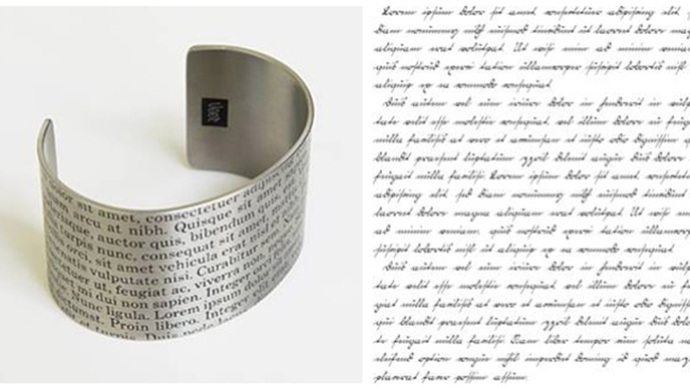
MISC: Lorem Ipsum - Layout Placeholder Text
When creating a design, layout or sample where there is no real text or visual material yet, the question arises - what to put in? Variations on this theme abound. Some write xxx, some paste an article from a news site, some scrape text from who knows where. But it turns out this problem has been solved. It's called Lorem Ipsum.
When creating a design, layout or sample where there is no real text or visual material yet, the question arises - what to put in? Variations on this theme abound. Some write xxx, some paste an article from a news site, some scrape text from who knows where. But it turns out this problem has been solved. It's called Lorem Ipsum.
What options are there:
1. Write a meaningless combination of letters.
Preferably of varying lengths, to evaluate line breaking. Sooner or later such meaningless writing will become tedious and text will be copied instead - resulting in the overall impression of the work not being entirely favourable.
2. Take ready-made text from, say, a news website.
A small problem - not all texts will work. Let's say texts about art, music or "nothing in particular" would be fine. But... even though the reviewer will understand your intention to incorporate contemporary features into the layout, the text itself might end up receiving more attention than the layout itself.
3. Use genuinely meaningless text, for example:
Lorem ipsum dolor sit amet, consectetur adipisicing elit, sed do eiusmod tempor incididunt ut labore et dolore magna aliqua. Ut enim ad minim veniam, quis nostrud exercitation ullamco laboris nisi ut aliquip ex ea commodo consequat. Duis aute irure dolor in reprehenderit in voluptate velit esse cillum dolore eu fugiat nulla pariatur. Excepteur sint occaecat cupidatat non proident, sunt in culpa qui officia deserunt mollit anim id est laborum.
Who the clever person was who first started using this seemingly meaningless text is unknown. From wikipedia.org we know only that it started being used around 1960 by a publisher, while other internet sources trace its use even further back - to the year 1500.
The text's origin is identified with Cicero's work - a treatise on the limits of good and evil, written in 45 BC. There are theories that this or a similar text had become an industry standard long ago. Even more - this text was used as a template by the first desktop publishing applications, for example Aldus PageMaker, back in 1985. For clarity I should also add that Aldus was acquired by Adobe in 1994.
Over these centuries the Lorem Ipsum text managed to change a little (perhaps intentionally?). Originally it looked like this: dolorem ipsum, quia dolor sit, amet, consectetur, adipisci velit, sed quia non numquam eius modi tempora incidunt, ut labore et dolore magnam aliquam quaerat voluptatem.
Interesting facts:
a) In Russian, this kind of "fake" text has its own term - «Рыба» (Fish)
Рыбу можно вставлять, использовать, вешать, заливать, показывать, запихивать... Словом, с ней можно делать что угодно, лишь бы эскиз был максимально похож на готовую работу.
(Translation: Fish can be inserted, used, hung, poured, shown, stuffed in... In short, you can do anything with it, as long as the sketch looks as close to the finished work as possible.)
b) English synonyms for such text (to put it politely):
- blind text
- dummy text
- greeked text
- placeholder text
- mock content
- filler text
c) Firefox has an add-on that generates Lorem Ipsum (https://addons.mozilla.org/en-US/firefox/addon/2064) :)
d) According to Artemy Lebedev, a designer should write such abstract text themselves, as it won't be completely meaningless and should be something the client can't reject the design over.
http://www.loremipsum.de/about_lorem_ipsum.html
http://en.wikipedia.org/wiki/Lorem_ipsum
http://www.artlebedev.ru/kovodstvo/sections/67/
comments