Web Technologies and Languages on Latvian Municipal Websites
From time to time, looking at a web page, the question arises of who built it and with what technologies. Although various IP and domain tools exist that allow extracting some information about the page owner, I recently came across a Chrome plugin - Wappalyzer - which allows identifying interesting information about a page without having to pore over the source code.
From time to time, looking at a web page, the question arises of who built it and with what technologies. Although various IP and domain tools exist that allow extracting some information about the page owner, I recently came across a Chrome plugin - Wappalyzer - which allows identifying interesting information about a page without having to pore over the source code.
Wappalyzer
Wappalyzer is a web browser plugin (for both Chrome and Firefox) which, based on various indicators, can determine what CMS or platform was used, the JavaScript framework, etc.
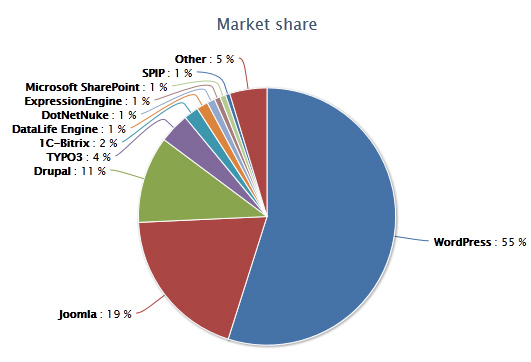
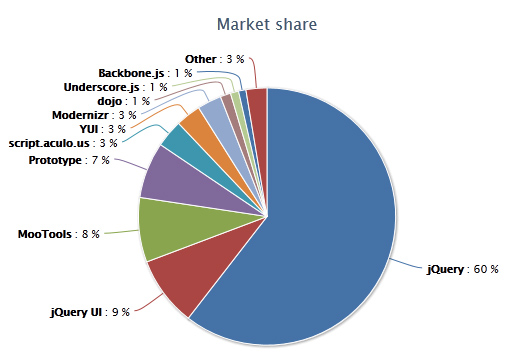
The Wappalyzer website also provides statistics on the usage of various web technologies over the last 30 days, evidently gathered from plugin users.
Latvian Municipal Websites
Since Wappalyzer does not offer statistics by country, driven by research interest I decided to look at what web technologies the developers of Latvian municipal websites prefer.
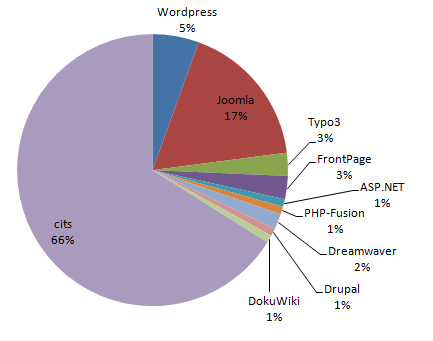
Out of 109 municipalities, the CMS could be identified for 37. Clearly the tool is not advanced enough to, for example, detect Jānis from Pampāļi's homemade CMS. Accordingly, it can be assumed that the remaining sites either have a locally built CMS or none at all.
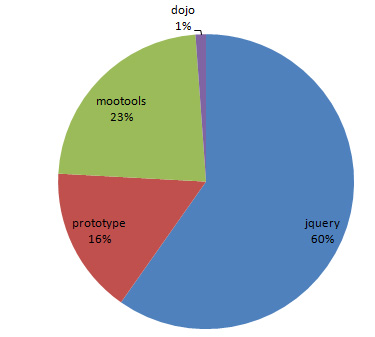
Conclusions:
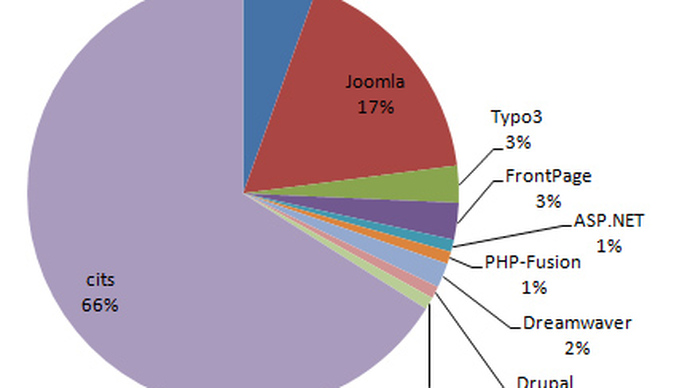
As can be seen, municipal website developers show a greater preference for Joomla (17% of the total), WordPress - 5%, Typo - 2.7%.
In terms of JavaScript framework usage, jQuery is preferred (47% of the total), MooTools - 18% and Prototype - 13%.
Looking at the websites of 9 cities, we see:
ASP.NET is used by Jēkabpils and Rīga, Drupal - Valmiera, Typo3 - Rēzekne. For the rest - unknown.
Use of Communication Languages
Although the use of communication languages is not the focus of this research, I would like to share a few observations. I examined in which languages general information and current information, for example news and current events, are provided.
Of the 9 cities, both general and current information in the most languages (LV, RU, EN, DE) is published in Ventspils and Jēkabpils. Jūrmala - LV, RU, EN but German - only for general information.
Latvian only - Liepāja, RU, EN, DE - only for general information.
Latvian and English - Valmiera. In other languages, including Russian, information was not found.
Border regions
Lithuanian border (Liepāja, Daugavpils, Krāslava, Bauska) - Lithuanian is not available on any of them.
Estonian border (Valka, Alūksne, Salacgrīva) - only Alūksne has general information in Estonian, the others - only Latvian and some general information in Russian and English.
Russian language in municipalities with a large Russian-speaking population
Looking at the results of the most recent referendum on bilingualism, the greatest activity was in: Daugavpils, Rēzekne, Ludza, Krāslava, Zilupe and Rīga, while looking at the summary table we see that only a few cities offer current city (as opposed to municipal) news in Russian as well.
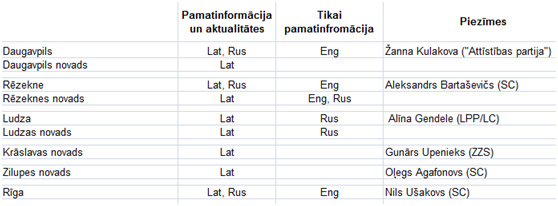
Conclusions:
Although considerable time has passed since the municipalities were established, they have largely still not utilised their websites as an information medium, providing information for both residents and tourists. This is especially true for border municipalities.
Meanwhile, in the municipalities which in the language referendum most actively expressed a desire to also use Russian in communications, the research shows that such communication is apparently not needed at all, since most likely:
a) few people contact the municipality,
b) the provision of information in Latvian is sufficient, since no one has requested the municipality to translate information into Russian as well,
c) non-governmental organisations have also shown no initiative to translate municipal news into Russian, suggesting that such a service is simply not needed.
Information was compiled in August 2012.
comments