
Happy and Unhappy Nations
The concept of happiness is much discussed in philosophy, psychology, and ethics. Happiness is viewed both as a constant psychological state of a person and as a momentary euphoria, a flash. Yesterday I came across a documentary where the state of happiness was analysed in relation to the world's countries and nations. From the analysis of accumulated data, a world map of the happiest and unhappiest nations was also created.
The concept of happiness is much discussed in philosophy, psychology, and ethics. Happiness is viewed both as a constant psychological state of a person and as a momentary euphoria, a flash. Yesterday I came across a documentary where the state of happiness was analysed in relation to the world's countries and nations.
It turns out the concept of happiness is also analysed statistically, compiling the subjective judgements about happiness of individuals from various nations. Dutch doctor of social sciences Ruut Veenhoven has created a world database of happiness - The World Database of Happiness. From the analysis of accumulated data, a world map of the happiest and unhappiest nations was also created. As we can see, unfortunately Latvia finds itself in the cluster of the unhappiest nations.
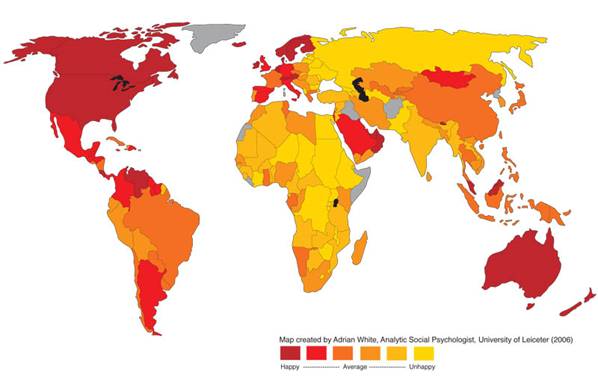
Analysing the causes, one naturally arrives at the correlation that the sense of stability and security inherited from generation to generation is an essential prerequisite for a person to feel protected and happy. It is precisely in countries that throughout the course of their history have experienced changes almost every century or every generation - wars, revolutions, economic crises, changes of political system, and the like - that the population feels depressed and the unhappiest. Not without reason do Easterners have the curse - "May you live in times of change." From the map one can clearly see that these are distinctly all the post-Soviet countries.
The countries whose inhabitants feel happy are Iceland, the Netherlands, Switzerland, Sweden, Austria, and not far behind - Canada, the USA, Norway, and Australia. Who is a happy person according to the research conducted? Someone secure, self-sufficient, and active, regardless of age. As an example, a Scandinavian family in their later years was cited - a married couple, one still working, the other already retired, with grown children who have gone out into the world - each undertaking some four activities per week. These include sports - Nordic walking - a handicraft circle, an opera lovers' club, free courses at the local folk high school, and similar.
The documentary expresses the thought that the sense of happiness should be a constant, natural state of a person, not brief, transient, turbulent experiences. Suffering, whose ennobling nature has been particularly celebrated in Russian literature, in reality does not promote a person's development but rather destroys the personality. Unfortunately, drawing parallels with Latvia, the role of suffering is deeply ingrained in our culture, literature, art, and upbringing as well. We perceive suffering as a natural part of our life. Have you heard in childhood the well-known phrase from adults - don't laugh so hard, or you'll cry bitterly later! But if you think about it - what is wrong with rejoicing from the heart, jumping for joy, savouring success to the fullest?! Could these fears, this insecurity about the future, and the uninculcated ability to rejoice be the cause of our nation's sense of unhappiness?
comments