Tangos
Viewed through the flamenco family tree, tangos originated mainly from the Romani music branch. This accounts for the sharp, accented movements, the strident sound, and the performance's focus on rhythm rather than melodic quality. The song or dance usually begins with clapping in the above-mentioned rhythm and continues throughout the entire performance, accentuating moments of climax and relaxation.
Every Tuesday evening at the flamenco dance studio Duende we learn Lidija's tangos dance technique and choreography under the direction of teacher Ilvija. It is not at all as easy as it initially appears when watching the Spanish dancers from the sidelines. Many sharp, rhythmic, fast foot stamps.
No wonder - looking into the etymology of the dance's name, I discovered that the root "tang" directly means a loud, definite sound produced by a percussion instrument. It is not without reason that the tangos dance is often accompanied by a percussionist's playing. Another origin of the word could be from the Latin "tangere" - "to touch". The word "tango, tangos" was used to denote the dance on both sides of the Atlantic Ocean, but the connection of tangos to the Argentine tango has not been proven.
Tangos originated in Cádiz - a south-western port city belonging to the autonomous region of Andalusia. One of the developers of the tangos musical style was flamenco singer Enrique Jiménez Fernández (1848–1906), known as Enrique el Mellizo.


The tangos performance style has a lively and markedly accented rhythm counted in four, where the first is the unaccented beat and the following three are accented. If we use the flamenco metronome, it sounds as follows:
Viewed through the flamenco family tree, tangos originated mainly from the Romani music branch (see diagram below). This accounts for the sharp, accented movements, the strident sound, and the performance's focus on rhythm rather than melodic quality. The song or dance usually begins with clapping in the above-mentioned rhythm and continues throughout the entire performance, accentuating moments of climax and relaxation.


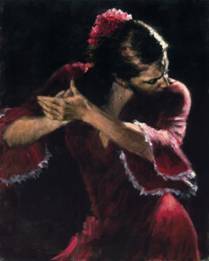
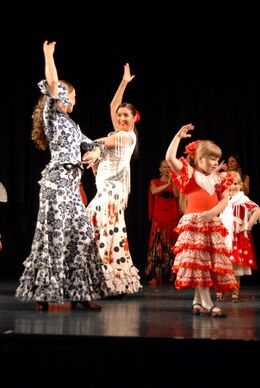
Marina Heredia - a flamenco singer (photo by Maque Falgas) and flamenco dancers in the works of Argentine-born painter Fabian Perez.
The tangos music we are currently learning is "Tangos de la Penca", performed by the flamenco singer Marina Heredia. To better understand the dance's emotional background, so to speak, I asked Duende dance teacher Aija to help with a translation of the song's lyrics from Spanish.
|
Tangos de la Penca. Zambra. Ay, puerto moruno de Tanger, Que ya no te veo más.... Ay, sa casao una gitana Y anda y vete con la otra A mi me han dicho que vienes del moro Ay, yo no quiero que me digas Ay, yo no quiero que me digas Que me quieres más que a nadie Ya viene el tren de las dos Ya viene el tren de las dos Ya viene el tren de las dos A mi me han dicho que vienes del moro |
The Ugly Romani Girl's Tangos. Zambra. Ay, Moorish gates of Tangier, I shall see you no more... Ay, a Romani girl was married, And I came and saw you with someone else, They told me you descended from a Moor, Ay, I don't want you to tell me that. Ay, I don't want you to tell me That you love me more than anyone The riders in carriages are already here, The carriages are already here, They told me you descended from a Moor, |
Sources used:
http://www.esflamenco.com/scripts/news/ennews.asp?frmIdPagina=212
http://en.wikipedia.org/wiki/Enrique_el_Mellizo
http://www.flamencoriga.lv/2010/06/marina-heredia-tangos-de-la-penca-zambra/
http://fabianperez.com/gallery.html
.jpg?w=690&mode=16x9|crop)


comments