Multiplication Tricks
Multiplication is one of the basic mathematical operations, which today is mostly performed with a calculator. In times long past, when there were no counting devices and no paper either, people devised all manner of tricks for obtaining a result from two multiplicands. So, on a few of those tricks.
Multiplication is one of the basic mathematical operations, which today is mostly performed with a calculator. In times long past, when there were no counting devices and no paper either, people devised all manner of tricks for obtaining a result from two multiplicands. So, on a few of those tricks.
Fortunately, multiplication is one of those mathematical operations that can be illustrated, for example, as follows: if 15 rabbits each eat 17 carrots, how many carrots in total will be needed to feed all the rabbits? The simplest (and most visual) solution would be to draw 15 rows of 17 carrots and count them. Setting aside the classical multiplication method, this time we will look at a few other approaches.
The Multiplication Sign
The classic multiplication sign is a "+" sign rotated 45 degrees - like this: "×". At school, meanwhile, they taught and possibly still teach to this day that the multiplication sign is a vertically centred dot - like this: "·". In computers and programming languages, the asterisk "*" is used.
15 × 17 = 15 · 17 = 15 * 17
1. Decomposition of a Factor
15 x 17 = (10 + 5) x 17, or 10 x 17 + 5 x 17 = 255
A number can be decomposed into any parts that are then easier to multiply.
2. Box Method
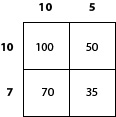
We split the numbers into tens and ones. One number is arranged horizontally (10, 5), the other - vertically (10, 7). In each cell we write the product of the numbers. The final result is obtained by adding all the numbers in the cells: 100 + 50 + 70 + 35 = 255.
3. Chinese Method (Grid)
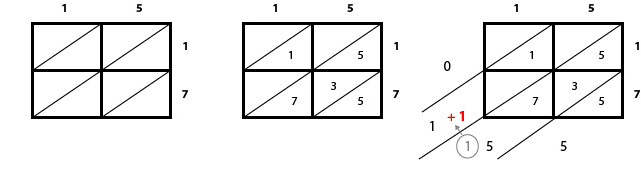
The Chinese method, or grid method, is somewhat similar to the box method but visually looks more complex. Possibly this method might prove simpler for some age groups, as the operations involve only small numbers.
We draw as many boxes as there are digits in the number. In our case, 15 has two digits (1, 5) and 17 - another two (1, 7). Each box is divided into two parts.
Each horizontal digit is multiplied by the vertical one, with tens written in the upper part of the box and ones in the lower part.
We extend the diagonal divisions of the boxes and add up the numbers. If a number is not single-digit (as in the example - 15), we carry the tens (1) one position to the left. The result we obtain is: 0 (1+1) 5 5, or 255.
4. The Unusual Chinese Method.
The origin of this method could not be established, but unlike the traditional Chinese method it looks much simpler, and it can be demonstrated with sticks, chopsticks or by drawing lines in sand.
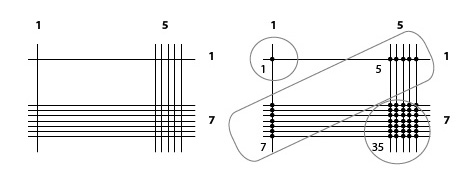
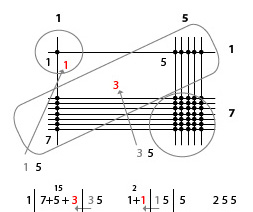
We split the numbers digit by digit, writing one along the top and the other along the right side. Both horizontally and vertically we draw as many lines as the value of each digit - respectively 1, 5 and 1, 7. We count where the lines intersect: 1, 7 and 5, 35.
If a number is two-digit, we carry the tens to the left.
In the event that the number of intersecting lines does not form a two-digit number, the task becomes considerably simpler - but this is not such a case. :)
In Closing
These are just a few multiplication methods. Although the mathematical operation seems straightforward, multiplying large numbers can even make a computer break a sweat. In higher-level programming languages the basic mathematical operations are already available, but if for some reason you decided to work in a lower-level language - such as Assembly - and experience the hardware first-hand, you will need to find an efficient algorithm for performing an operation as seemingly simple as multiplication.
comments