Getting Around by Bike, or the Unspoken Truths
If you have not yet become a cyclist but are considering the idea, you will most likely mentally run through the full cycling cycle from purchasing a bicycle to storing it. Not because there is anything complicated or difficult to overcome in this process - rather, it is new and unfamiliar.
If you have not yet become a cyclist but are considering the idea, you will most likely mentally run through the full cycling cycle from purchasing a bicycle to storing it. Not because there is anything complicated or difficult to overcome in this process - rather, it is new and unfamiliar.
1. Purchasing and Storing a Bike
You can buy a bicycle for 300 EUR or for 2,000 EUR. You can also buy a rusty iron steed for 20 EUR. It all depends on whether it will be your means of transport, a hobby item, or a status symbol. The first problem is where to store it at home. The problem becomes more obvious if, however small the flat, you need to store not one but two or more bicycles. Those who have access to basements, garages or some other type of parking are quite fortunate. It is a well-known fact that bicycles get stolen, and unlike cars, they have a rather limited range of protective devices.
The destination. Usually it is the office or school. Accordingly, there may or may not be a convenient bicycle parking there. Of course, one can just "not give a damn" and drag the mud-covered steed into the office, where it will take up approximately 2 square metres. If office rent is 7 EUR/m², then keeping your steed there will cost 14 EUR per month.
2. Riding
It comes as no surprise that the cycling movement - which in heated exchanges is sometimes called "cycle fascism" - is concentrated in big cities. Very possibly this is connected with the fact that in small towns and the countryside people have been cycling since childhood and in adulthood there is no longer such a desire for it. It is likely that the so-called cycle fascists cannot imagine that riding dozens of kilometres to school along an uncleaned road in winter or in the damp and darkness of autumn is neither romantic nor enjoyable.
Alternatives. What to do if it starts to rain, snow, or something happens to the bicycle? In Riga, you are permitted to push your iron steed into the packed public transport, receiving in return a grumbling full of passengers' dissatisfaction. Depending on how packed the transport is, that may not happen. You can travel by train, though it seems you need an extra ticket for that. On intercity buses, that option does not exist. In cities everything is straightforward - if the weather turns bad, you can also take public transport or even a taxi home, leaving the bike at the office or school. Bad weather conditions, in terms of inconvenience, are comparable to forgetting an umbrella at home.
The biggest trump cards of a taxi and a private car are the ability to carry cargo and the speed of travel. If the time spent on the road matters to you, getting around by bike might not be a good alternative, unlike walking.
3. Expenses
The concept of expenses is in itself a relative concept. They become large or small compared to your salary or other alternatives. It is particularly important to be aware of indirect costs.
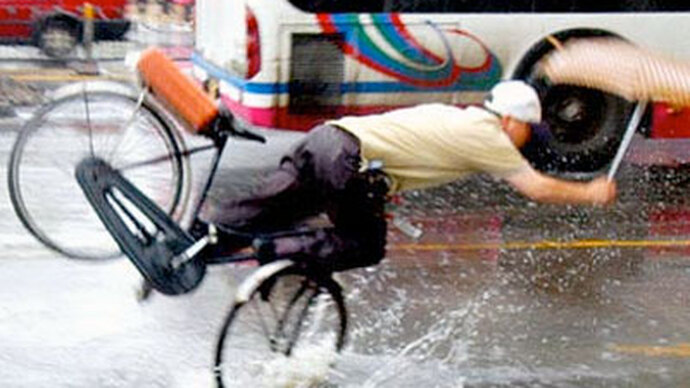
a) Injuries. Where there is speed and inertia, injuries are inevitable. However carefully one rides, one must remember that there are a number of factors beyond your control. Even riding in quiet solitude along a forest path without disturbing anyone, you might run over a hare, slip and fall. There is no data on how many pairs of trousers, dresses and jackets are torn this way. It is not known how much the state has "forked out" for medical and rehabilitation expenses.
b) Clothing. You can ride a bike in a suit too, if that brings you satisfaction. However, it would be more sensible to choose outdoor-appropriate clothing and change into a suit at the office. Bear in mind that you will sweat more when cycling, meaning you will also need to change and wash your clothes more frequently. These may be minor costs, yet they are ones you would deal with to a lesser degree when driving a car.
c) Food. Since cycling is physical work, it is logical that energy will be expended and calories burned. Cycling for one hour will consume approximately 500 kcal. A person needs approximately 1,500 kcal per day. So bear in mind that cycling will not only make you sweat a lot, but also eat a lot. In 2015, it was calculated that a family of four spends 300 EUR per month on food. They probably spend another 300 EUR eating outside the home (lunches). That is approximately 150 EUR per person. If you decide as a whole family to switch from a car to bikes, food consumption will increase. Perhaps not by half, but nonetheless. Mechanically calculated, it will increase by 75 EUR per person.
4. Socialisation.
Another common myth among cycling enthusiasts is that cycling offers greater opportunity to socialise. Especially if you ride with music plugged into your ears, at such speed that the wind whistles past, someone will definitely want to talk to you, but you to answer. :) Let us be realistic - one of the strong facilitators of socialisation at our latitude and mentality is alcohol. It is perfectly possible that alcohol is not important to you and your friends and you can do without it, but you would surely agree that socialisation is connected to personality traits, not so much to lifestyle, and even less so to whether or not you ride a bike.
5. Ecology.
An important argument by cycling enthusiasts in favour of cycling is its ecological nature, since, as is known, cars produce emissions. Cycling enthusiasts and car enthusiasts are like a dog and a cat, like Vienotība and Saskaņa, like Yin and Yang. Citing as illustrative and instructive examples studies from Denmark or the Netherlands. If we look at the CO2 emissions table, Latvia produces 3.63 tonnes of CO2 emissions per person per year, or 0.02% of total global emissions. Estonia - 13.77 t/person, Denmark - 8.34 t/person, the Netherlands - 10.95 t/person, and the USA - 17.56 t/person. For Latvia, the emissions problem is simply not a problem. The problem of unclean streets - dust - is a municipal political decision, where instead of cleaning the streets they chose to provide free rides for pensioners, because no one will vote for clean streets, but they will for free tickets!
Cycling has one great advantage - physical activity. Unless you live in the countryside or a small town, where physical activity is already plentiful, that is an important argument. The second important argument - mobility. You can set off whenever you want. Even at night, if needed. Ride wherever and however you want, stop wherever and however you want. In my opinion, the existence of dedicated cycle paths, which inevitably dictates the rhythm of travel, ruins this pleasure and cycling turns into getting from one end of the cycle path to the other.
I do not wish to convince or dissuade anyone from joining the thigh-drill cult. I merely illustrate that a large part of the arguments in favour of cycling are not serious and can simply be countered with counterarguments. It is important to remember that pleasure comes from freedom of choice, not from imposed values. If cycling brings you joy - do it! If walking brings you joy - walk! If driving a car or a vespa brings you joy - drive!
comments