
When Is the Right Time?
Nowadays the accepted wisdom is that one should change jobs every five years, but many also acknowledge that a job should be changed not when a set time has passed, but when one simply can no longer stay where one is - guided by inner feeling. What is the optimal length of time a person can work in one job without reaching "burnout" or professional distortion? That is, how long can one do the same work day in, day out, without losing one's inner "spark"?
Nowadays the accepted wisdom is that one should change jobs every five years, but many also acknowledge that a job should be changed not when a set time has passed, but when one simply can no longer stay where one is - guided by inner feeling.
At the same time, employers, upon receiving CVs and applications for an advertised vacancy, look with a degree of suspicion upon employees who have changed jobs fairly frequently - for example, who have not stayed in one place for more than a year. Calculating purely statistically, if a person were to change jobs every five years, they would work in at least eight workplaces during their productive life.
What is the optimal length of time a person can work in one job without reaching "burnout" or professional distortion? That is, how long can one do the same work day in, day out, without losing one's inner "spark"? Here is a glimpse at the results of this small survey.
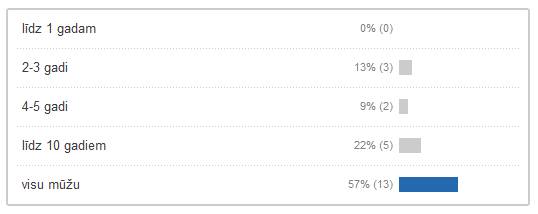
As can be seen, the majority of respondents prefer to work long-term in one place and not seek new opportunities. In my view, this could be determined both by the Latvian mentality and by the social vulnerability prevailing in the country. A person who loses a job in Latvia experiences considerable stress, because there is no sense of security that could be provided by savings for unforeseen life circumstances, a benefits policy, or a high corporate culture. One has heard many accounts of job interview candidates being placed in the role of second-class citizens, or most elementarily, of applications for advertised vacancies receiving no response whatsoever. Even an acknowledgement of receipt of an application or a courteous rejection reveals a company's culture.
Here also are some reflections from survey participants on the topic:
"I once heard that 7 years is a kind of optimal cycle for this. Personally I think it can vary enormously. There are places where you don't need even a year - and then you burn out completely. And there are places that constantly allow you to grow, learn, develop, and you don't even notice that you've actually been in one and the same place."
"Yes, I also agree that 7 years is optimal, but there are people whose current job is the calling of a lifetime! A person improves themselves and takes an interest in their work and does their work with the greatest conscientiousness and feels useful to society. My own time in one workplace is 14 years. And I would have been happy to continue it, if the work quality of state officials were more conscientious!"
"Well that is very individual - if you find the ideal job with ideal management, opportunities for growth and good colleagues - then for a whole lifetime, but in my view while a person is still young, it is good to gain experience in several jobs and not sit in one place...."
"I have been in my workplace for 25 years, and it is fantastic, because I am learning all my life, every day I master and discover something new - I am always interested... still..."
"Working in one place my whole life - that would bore me. I want to gain more experience from this life, and the pleasure it offers."
"If the work is enjoyable and the interest is great, then you always do it with joy :) - not counting the time!"
And yet, what is that inner feeling that tells you: it is time? In some sources it is explained as the moment when you no longer see any opportunities for growth or personal development within the given company. So if such a stage sets in, it is not worth staying any longer and one must go forward to meet new challenges, in order to be able to demonstrate one's knowledge, skills, and abilities, and most importantly - to acquire new ones.
Sometimes such advice can mislead people who read it and take it as a norm. An employee who has long worked in one place may begin to think: if I've been here for ten years already, it means something is wrong with me. But in reality, everything is fine if what you are doing is done with integrity and with pleasure in the work itself.
Of course, some may object right now that it is not worth discussing options for changing jobs at a time when the country's unemployment level has now reached 18%. Would the wisest course be to stay in the current job and continue performing one's duties without any initiative? In my view, this is undesirable - both for the employee, as it can lead to serious "burnout", apathy, and even emotional breakdown, and for the company - a decline in labour productivity and a deterioration of attitude towards colleagues or the company's clients.
In order not to reach such a breaking point, the employer must take care of their employees, and in reality, employees must also know how to take care of themselves - both their physical and emotional wellbeing. Speaking of the latter - if you are a sufficiently energetic and open person, do not be stingy with kind words, a smile, and verbal encouragement, because by transmitting positive emotion into the surrounding environment, you will mostly receive the same in return. Moreover, if you are a more introverted person, find a heart-pleasing activity (here I mean various pastimes and hobbies) that could counterbalance the difficult situations encountered daily at work.
I do not think the best option is to come home from work, collapse on the bed from exhaustion, and think about how bad everything is and that nothing can be changed. Perhaps think about how to improve your work in the workplace, introduce something new, start doing something differently from every day? Perhaps after each conversation with a client to wish them - Have a lovely day?! To invite a long-unseen friend for a truly good cup of coffee in a cosy, well-appointed café - never mind if there is not enough money for a pastry. To go dancing, exercise, participate in a community clean-up or some charitable action. There is a good saying: "Work protects us from three great evils: boredom, vice, and want" - which applies not only to paid work, but to activity in general.
comments