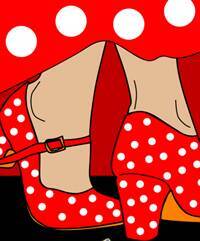
Sevillanas
Sevillanas is the first of the flamenco dance styles I have started to learn at the Spanish dance club Duende. Of course, one must start from the most basic movements - learning posture, arm movements, counting the rhythm, and then the steps. Classes take place in small groups, which is beneficial in that dance teacher Ilvija can give individual attention to each person, correct mistakes, and monitor the execution. The hour allocated to each class passes unnoticed. What follows is a little about sevillanas itself.
Sevillanas is the first of the flamenco dance styles I have started to learn at the Spanish dance club "Duende". Of course, one must start from the most basic movements - learning posture, arm movements, counting the rhythm, and then the steps. Classes take place in small groups, which is beneficial in that dance teacher Ilvija can give individual attention to each person, correct mistakes, and monitor the execution. The hour allocated to each class passes unnoticed. What follows is a little about sevillanas itself.
The Dance
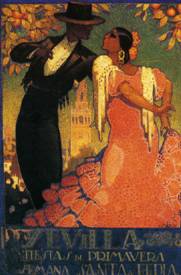
Sevillanas is one of the best-known flamenco dance styles. It was once danced in patios or guest houses at neighbourhood gatherings, also known as corrales, and people have always danced it at romerías and other festivities. The dance and its name originated from the Seville region of Spain, where it is especially popular in neighbourhoods such as La Macarena, San Bernardo, La Feria, and La Alameda Triana.
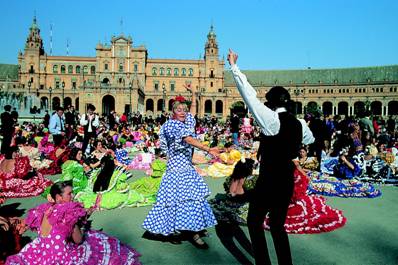
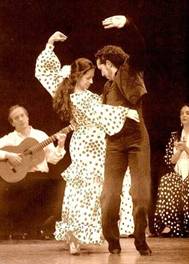
The dance is characterised by elegance, liveliness, sharp dynamics, and movement, although in the last couple of years it has become somewhat slower. Sevillanas is a partner dance - a man and a woman, or two women. It is mainly performed in four parts (4 coplas), each with different choreography and a brief pause between them.
The most significant movements are paseíllos (a ceremonial introduction or series of steps resembling a walk), pasadas (partner change), careos (partner change while facing each other), and remate (the closing section of the dance emphasised with movements). When the final beat is sung, the music and dance stop simultaneously and the performers end with an elegant and challenging desplante (strong stamps that end or culminate a series of stamps or a section of the dance), characteristic of dances of courtship.
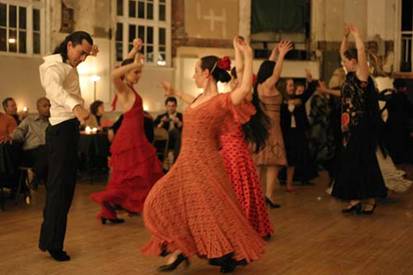
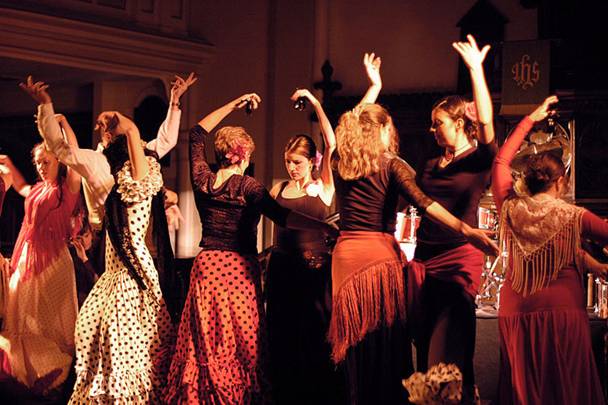
Expressive hand and finger movements are important in the dance, and are practised at length and thoroughly in dance classes. Shoulders down, elbows never for a moment lowered, fingers spread wide like a fan and close into a fist, with the wrist performing a circular movement. Fluidity, but at the same time tension and strength in every curve of the wrist.
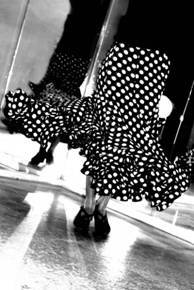
One variant of sevillanas
The feet seem to dance sovereign rhythmic steps, which do indeed resemble more of a walk, as there are not the sharp, swift heel stamps of other flamenco styles. One also needs to get accustomed to the rhythm and a different way of counting beats, which bears no resemblance whatsoever to the Latvian folk dances one is used to.
Rhythm
The rhythm is counted 3 times in groups of 4, i.e., in 3. This means that the first beat is stronger and the next two are weaker - 1 2 3 4 5 6 7 8 9 10 11 12
Song
Sevillanas is a popular folk song that is aflamencada (flamenco-influenced, i.e., changed under the influence of flamenco), and has been very widely played for many years. Several sevillanas variations can be distinguished: corraleras (for neighbourhood patios), bíblicas (with biblical themes), boleras, liturgícas (with liturgical or religious themes), de feria (typical for festivals), and rocieras (for the rocío festivities). Sevillanas songs are performed by such popular groups as Los Romeros de la Puebla, Los Amigos de Gines, Las Corraleras de Lebrija, Cantores de Hispalis, and Los del Río.
Performance
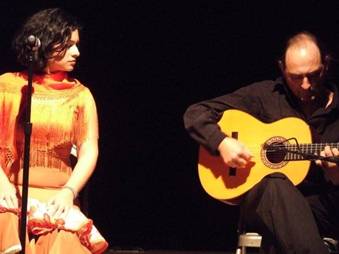
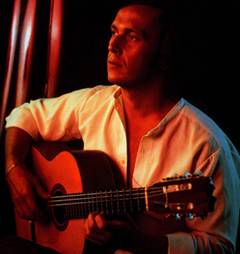
On guitar, sevillanas can be played in various keys, as it depends on the pitch set by the singer. Traditionally it is played in A minor and the middle section is performed in D minor. Percussion instruments are often used for accompaniment, or the rhythmic accents are performed by the dancers themselves with castanets.
Sources used:
http://www.duende.lv/wtf.php
http://en.wikipedia.org/wiki/Sevillanas
http://www.esflamenco.com/palos/ensevillanas.html
http://www.flamenco.ru/flamenco/articles/index.html
.jpg?w=690&mode=16x9|crop)
comments