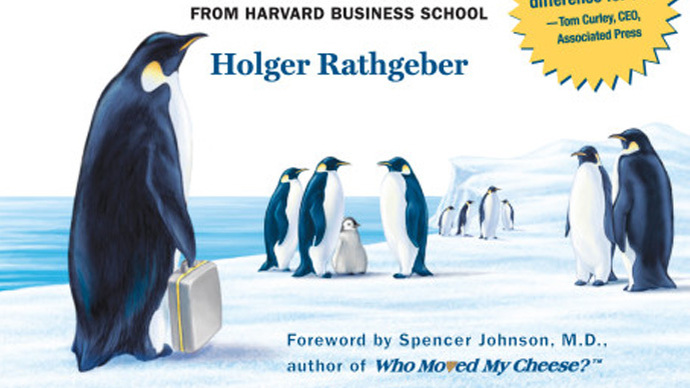
Our Iceberg Is Melting
This Tuesday I received a phone call from a representative of Zvaigzne ABC congratulating me on having entered a competition and won the widely praised book by J. Kotter and H. Rathgeber "Our Iceberg Is Melting". The book essentially uses allegory to tell an eight-step programme for successfully implementing change in a company, a country, a family, or a relationship. It brilliantly portrays various character types of people - sorry, penguins - and their behaviour in critical situations. Yet at the end, looking at it with a critical eye, I found myself with a series of "buts".
This Tuesday I received a phone call from a representative of Zvaigzne ABC congratulating me on having entered a competition and won the widely praised book by J. Kotter and H. Rathgeber "Our Iceberg Is Melting". I shall have to go and collect my prize with head held high, as one of three competition winners - http://www.zvaigzne.lv/lv/apgads-zvaigzne-abc/konkursi/article.php?id=24968 :)
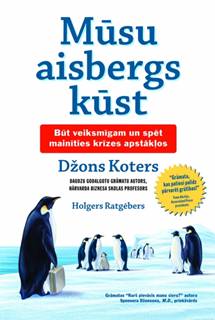 The joy would be even greater if I hadn't already had the chance to read this book. (Ah, my impatient Aries nature!) In one evening I had "devoured" the entire book from cover to cover. In terms of font size and large colourful illustrations it resembles a children's picture book. For a proper Latvian there's not much to read there.
"Our Iceberg Is Melting" is a fable about a colony of penguins that has lived on an iceberg in Antarctica since time immemorial. As winter approaches, one of the penguins, Fred, discovers that the iceberg has begun to melt and will most likely not survive the approaching winter. This would lead to the death of a large portion of the weaker penguins. Fred turns to the penguin Council of Directors and persuades them to act. When the information becomes public, some penguins assess the facts, some panic, while others put their heads under their wings and are afraid.
The book essentially uses allegory to tell an eight-step programme for successfully implementing change in a company, a country, a family, or a relationship. It brilliantly portrays various character types of people - sorry, penguins - and their behaviour in critical situations. Reading it, you can easily recognise your colleagues, your boss, your husband, your friends - and yourself.
The role of a leader in forming and uniting a team is well shown, according to the finest principles of team-work theory. Each has their own role in the team; each carries out the entrusted task according to their abilities and talents. Head Penguin Louis - wise and experienced, slightly conservative, but respected by all or almost all. His is the final word in all discussions. Penguin Alice - a practical person, energetic and persistent; she knows how to persuade, get her way, listen, and her judgement is not influenced by status differences between penguins. Penguin Buddy - attractive but not overly sharp or wise; possesses friendliness, openness and charisma. Fred - an inquisitive, creative and extraordinarily observant young penguin. The Professor - educated but not particularly sociable or flexible; reasons logically, analyses, draws conclusions.
The importance of the team is illustrated even in this quote, which strikes me as both comic and yet informative and engaging - "On land, penguins are clumsy and waddle like Charlie Chaplin, but in water they move with incredible agility and can manoeuvre better than a $250,000 Porsche. Yet all of that counts for nothing if a penguin wants to catch a squid on its own."
This and many other examples from management psychology - on how to foster change and success, how a change in attitude can change behaviour, and so on. Thoroughly positive and instructive, good for refreshing and updating what one has heard and discussed at various conferences and seminars. The good old Belbin team roles theory and American business school insights.
Yet at the end, looking at it with a critical eye, I found myself with a series of "buts" -
1. This is a very "American" or "Western" iceberg, where from the time tiny flippers were small the little penguins have grown and developed in a different educational and family model, with a different value scale. What I mean by this - for example, Latvians unfortunately have not been brought up with the habit of "going and speaking up" (I can't even put a name to the quality), an uncertainty about anything - "who am I to say"; "what if I'm wrong"; "what if no one listens to me"; "why bother, nothing will change anyway".
2. The authors offer as a solution to the situation - leave the iceberg and go to another, because conditions are better there, nothing threatens you, there are opportunities to develop and grow. If you take this literally from this example, then when there is a crisis in Latvia and a good specialist is being paid a salary that barely gets them from one month to the next - let alone any savings - then in order for one's family's or one's own financial situation to improve, one must leave the country, go to Ireland or another country, earn a decent wage, support a family where the wife can afford not to work, have three children and live comfortably? Moreover, it doesn't matter whether the child's or grandchild's passport says "Latvian" or "Irish". Or should one immediately leave the company that may (as heard in the corridors) be facing insolvency, because a competing company is flourishing? Or should one abandon a family or relationship without a guilty conscience, if it so happens that the other person has lost their job or good health and now you alone must support everyone and carry it all on your shoulders? Whatever happened to that Latvian value orientation, cultivated over years and generations - to hold on to your land, tend your father's homestead, prove your worth through work and deeds, not through talking, and so on.
3. The Head Penguin is willing to listen and not afraid to take responsibility in order to act, rather than sinking into complacency and self-indulgence. If the penguin Council of Directors had not moved a flipper, believe me, no activist could have made an entire colony change the habits of their ancestors and embrace different values.
comments