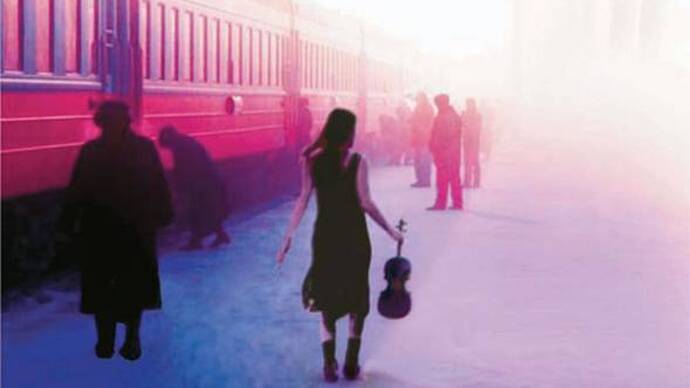
Paulo Coelho "Aleph"
The recently published Latvian edition of Paulo Coelho's book "Aleph" (2011) is the author's message about the relativity of time, for everything is happening right now - there is no past, nor a predetermined future. Essentially the entire central idea is expressed in the book's very title. The Aleph is a point where absolutely everything exists simultaneously in one place.
The recently published Latvian edition of Paulo Coelho's book "Aleph" (2011) is the author's message about the relativity of time, for everything is happening right now - there is no past, nor a predetermined future. Essentially the entire central idea is expressed in the book's very title. The Aleph is a point where absolutely everything exists simultaneously in one place. In mathematics, aleph denotes infinity; in the Hebrew, Arabic and Aramaic alphabets it is once again the first letter. For the author, the Aleph is a state in which he can travel through time and space, visit his previous lives and understand the patterns and seemingly chance encounters of this life.
"All people with whom we have had any kind of conflict 'in the past' return to our lives once more."
"Most encounters are the consequence of various unresolved questions, and we need a new incarnation in order to put interrupted events back on the right track."
The storyline of the book is the author's 9,288 km journey on the Trans-Siberian Railway from Moscow to Vladivostok, with the aim of meeting Russian readers. But in reality this journey is a search for his own kingdom. The author is accompanied by two colourful personalities: Hilal - spalla (first violin in the orchestra) - a 21-year-old girl who in a past life was accused of heresy and burned at the stake; and Yao - an old professor, a translator who practises aikido and has also grasped the philosophy of martial arts. The latter shares his insights throughout the entire journey. Here are a few of them:
"If you want to see the rainbow, learn to rejoice in the rain!"
"Train the heart. Every warrior must learn this. If you govern the heart, victory will be on your side."
"To live means to train. By training we prepare ourselves for tomorrow. Life and death lose their original meaning; there are only challenges, which we greet with joy and overcome with calm."
"Dreamers cannot be tamed."
Hilal, meanwhile, follows the author in response to some inner calling, gifting him her music, her love and with it her forgiveness. Forgiveness for the wrong done in a past life, for the author had in a previous existence been one of the members of the Holy Inquisition and delivered the girl to the pyre, even though there had been feelings of love between them. Hilal's conviction: "The words 'I forgive you' can only be said by someone who is capable of saying 'I love you'." The author, however, believes: ".. but love is a choice, and it is a human being who makes the choice."
Receiving or asking for forgiveness or help is a process that is alien to many people - especially those who from early childhood have learned to stand on their own, have built themselves a secure foundation and an equally secure fence, so that as few storms of life's experiences as possible can reach them.
".. very few people gladly accept anything - even when something is given with love and from the whole heart. It seems that the act of receiving places many people in a kind of inferior position and makes them bristle at dependence on someone else. Such people think: If someone gives us something, it means we are great failures and cannot achieve it by our own means. Or: The person who gives today will demand it back with interest tomorrow. Or even worse: I do not deserve what someone wants to give me."
In one Russian city one evening, Yao gives the author an assignment - to stand on the street with a plastic cup in hand and beg for alms. At first it seems absurd, does it not? Why ask for anything when you have enough of everything, are sufficiently well-off, loved and protected? But this too is one of life's lessons. He who does not ask shall not receive; he who does not knock, the door shall not be opened.
".. it is not what you have done in the past that influences your present. It is your actions in the present that free the past and influence the future."
"He who knows God cannot describe Him. He who tries to describe God does not know Him."
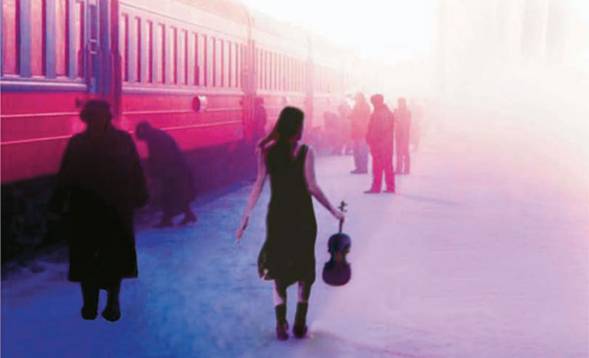
The Trans-Siberian Railway line is the means by which the author travels across vast Russia and meets and comes to know several people, but it symbolically reflects each person's life. The author declares: "Life is a train, not a station." We move from carriage to carriage, and so on without cease until our mission is fulfilled.
".. do not be afraid of other people's opinions! Only mediocre people are sure of themselves - take risks and do what you truly want! Choose as friends people who make mistakes because they are not afraid to take risks. And whose achievements are therefore not always recognised. Only such people are capable of transforming the world, and after many mistakes they reach a goal that completely transforms their immediate surroundings."
"When faced with loss, there is no point in grasping at what has been lost; one must seize the opportunity and fill the emptiness torn open in the flesh of life with something new."
Every person we encounter in our life teaches us something, gives us something. Perseverance in following one's dream and the consequent achievement of a goal is made clear to the author by both his agent Monica and by Hilal. Both stubbornly convincing him that they are needed by him in order to help fulfil his mission.
"This is the quality of a true warrior: to understand that willpower and courage are not one and the same. Courage can make an opponent afraid or cause them to flatter, whereas willpower demands patience and the art of compromise. People of great will are usually very lonely; they radiate coldness."
But sometimes the most important thing one wishes to receive is a simple embrace. An ordinary gesture, yet so saturated with positive energy. By giving another person an embrace, you give far more than you can imagine.
"Today I want only an embrace. This gesture is as old as humanity itself, and it expresses far more than the contact of two bodies. An embrace seems to say: In your presence I feel safe, and I am not afraid; I can relax and feel at home; I am protected and understood."
comments