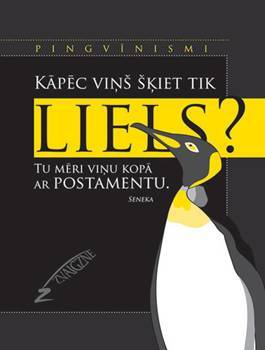
On Friday evening I happened to wander into the J. Rože bookshop on Krišjāņa Barona Street. My gaze stopped at a small black book whose cover character would not let me pass by indifferently. As it turns out, books can collect not only aphorisms but also witty penguin-isms. As you can imagine, the book instantly claimed one of the places of honour in our home library.
It feels strange when a peer departs (1977–2011). It seems so much has been, so much still ahead. No one truly knows where we come from or where we go. Perhaps we continue living in a parallel world, perhaps we are reborn, transformed, say, into a rabbit eagerly nibbling a tasty dandelion leaf. That was Mārtiņš's vision. A brief glimpse into Mārtiņš Freimanis's poetry collection "Little Grass for a Rabbit's Soul" (Mandris, 2004).
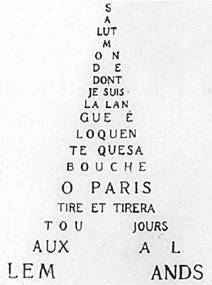
This morning, drinking coffee and watching through the window as the wind raged while the sun felt almost spring-like despite it still being the tail end of January, I thought I would look for poetry readings on YouTube as a wonderful backdrop. Unfortunately one must note that poetry readings in Latvian are exceedingly scarce. I had to dig out the notebook from my student days, in which a few compositions by French modernists had been diligently copied out.
I first heard the "Sleepwalking Romance" by the celebrated Spanish poet Federico García Lorca in Marianna Verdecia's flamenco rumba masterclasses, performed by Agustina de Cantarote. Captivated by the sound, I also sought out the poem's text online. Lorca's poetry embodies elements characteristic of Surrealism and in particular Symbolism.
Autumn strikes me as a very laconic month, with no superfluous words, needless movements or stormy expressions of feeling. My mind unexpectedly recalled a Japanese three-line poem read long ago and, for some reason, lodged in memory: "I depart. You remain. Two autumns." /Yosa Buson/ Tonight, as cold autumn rain falls outside the window, I invite you to read some haiku together.
The last time I chose two books - the first by flicking through it and understanding from a few text fragments that it would be quite engaging; the second feeling intrigued both by the blurb on the back cover and by the fact that the book could not be opened - it was wrapped in cellophane. This brought to mind the thought to observe how people actually choose books to read.
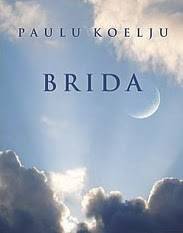
I read the new Paulo Coelho book "Brida" (Jāņa Roze publishing house, 2010). The author did not disappoint. I am glad I bought it. A story about a year in the life of an Irish girl that changed her view of the world, its order and herself. A story about the search for one's Other Half and the development of inner Gifts.
It is solely due to the uniqueness of my personality that some fine day people will be forced to take an interest in my works as well. This is far more effective than groping through an artist's body of work in search of his personality. /Salvador Dalí/
Living with full responsibility - that is perhaps the hardest of all tasks in this life. It is much easier to seek new paths to wisdom or try to change the world rather than to look inside oneself and try to change oneself. It is much easier to become an activist fighting corruption than to fight one's own egocentric impulses. This book is not light evening reading, as every page is saturated with existentialist questions and the endlessly promised revelations that only Kabbalah - and no other source - can provide.
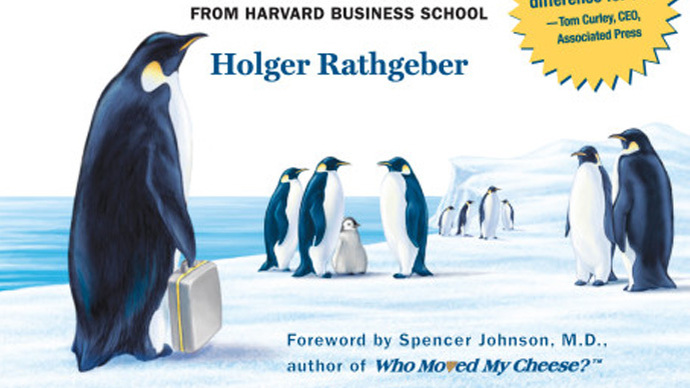
This Tuesday I received a phone call from a representative of Zvaigzne ABC congratulating me on having entered a competition and won the widely praised book by J. Kotter and H. Rathgeber "Our Iceberg Is Melting". The book essentially uses allegory to tell an eight-step programme for successfully implementing change in a company, a country, a family, or a relationship. It brilliantly portrays various character types of people - sorry, penguins - and their behaviour in critical situations. Yet at the end, looking at it with a critical eye, I found myself with a series of "buts".