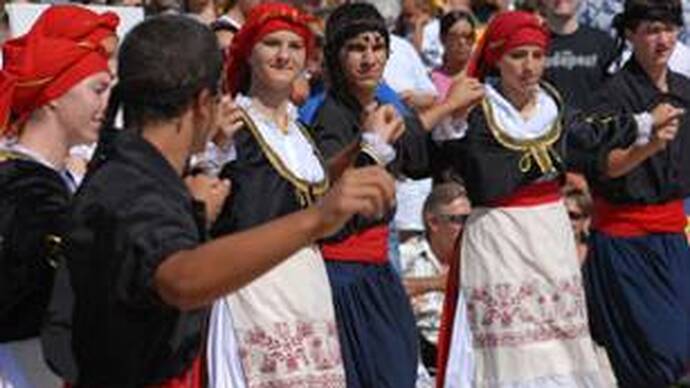
Sirtaki - A Greek National Dance?
Sirtaki (συρτάκι) is widely regarded as an integral symbol of Greece and considered to be a Greek folk dance. Although this dance is gladly danced in Greece today, it turns out that the belief about its roots is mistaken. Whatever the case, sirtaki can be considered proof of what dance and dancing mean to the Greeks.
Sirtaki (συρτάκι) is widely regarded as an integral symbol of Greece and considered to be a Greek folk dance. Although this dance is gladly danced in Greece today, it turns out that the belief about its roots is mistaken.
The famous sirtaki - or Zorba's dance - melody was composed by the outstanding Greek composer Mikis Theodorakis (Μίκης Θεοδωράκης, 1925) for the film adaptation of the novel "Zorba the Greek". The film Zorba the Greek (1964), with Mexican-American Anthony Quinn in the lead role, won three Oscars and four Oscar nominations, while the sirtaki melody and dance steps quickly became one of the most popular elements of tourist entertainment in Greece.
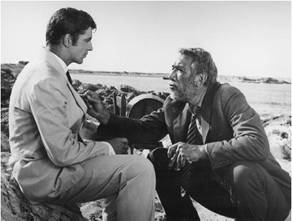
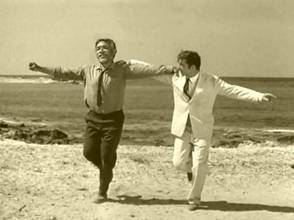
A scene from the film
The classic novel by Nikos Kazantzakis (Νίκος Καζαντζάκης, 1883–1957) about the proud Cretan Zorba vividly conveys what dance and dancing mean to the Greeks.
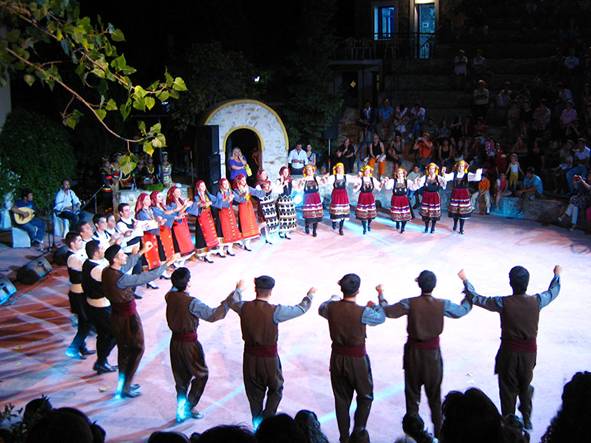
Every village in every region of Greece has its own patron saint, and every year each village holds a great festival in that saint's honour, lasting several days, sometimes even a week. During this time, there is much eating, drinking, singing, and of course dancing.
Most Greek dances are characterised by dancers standing in a line one behind the other, with the left hand (palm facing upward) receiving the right hand of the dancer to the left, and the right hand (palm facing downward) extended to the dancer on the right for them to take. The proportion of partner dances is very small. There are dances danced only by men or only by women. Since it was impermissible for a woman's ankle to be visible during dancing, women's dances are usually slow and without swift movements.
At festivals, almost all the village residents would line up in such a row to dance through the village and the surrounding area. The dance steps were always led by a man, usually the village elder, who also determined the order of the dances. After a longer period the dance leaders were replaced, chosen according to various criteria and depending on the occasion. Sometimes the opportunity to lead the dance and demonstrate one's skill in forming figures could be purchased; sometimes this honour had to be earned through hard work. Men often also competed with their fists for the chance to be at the head of the line of dancers.
Different regions of Greece have different rules according to which dancers line up, which also depends on the particular dance. In the north-western Greek region of Epirus, where dancing traditions are still observed and cultivated very strictly, married men stood first - eldest at the front, then the younger ones - followed by men from the oldest unmarried to the youngest unmarried, then came the women in exactly the same order - from the oldest married woman to the youngest unmarried - and at the end stood the children, eldest first, the very youngest at the back.
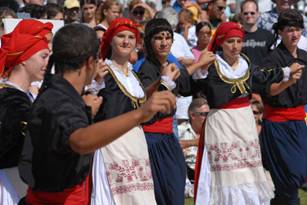
There are five important dances that are danced always and mostly in exactly this order: 1) sirto, 2) balos, 3) karsilamas, 4) zeibekikos, 5) hasaposervikos.
Sirto (Συρτός) in various forms is found in every Greek region, and the steps of the sirto form the basis of many other Greek dances (sirtaki is a diminutive of the word sirto). The dancer moves counter-clockwise, stepping to the side with the right foot and then with the left foot - depending on the variant - a step forward or behind, followed by two more side steps with the right foot, lightly, as if rocking, bending at the knees. Balos is an erotic dance, danced in pairs, and is considered to imitate the courtship ritual movements of doves.
Zeibekikos is a dance that in former times was danced only by men, and it symbolises male courage. The dance is very slow, and as a result performing its steps demands agility and endurance. The finest dancers could perform the zeibekikos steps in a very small space (often on a chair) and to very slow music.
At weddings, the bridegroom would dance his way through the entire village to the accompaniment of music, and the village's inhabitants would present the skilled dancer with gifts. This tradition can still be found today when a young couple has chosen to celebrate their wedding in accordance with Greek folk traditions.
Sources used:
http://www.m-saule.lv/modules.php?op=modload&name=News&file=article&sid=502
http://en.wikipedia.org/wiki/Sirtaki
http://en.wikipedia.org/wiki/Mikis_Theodorakis
comments