
The Flavour Charm of German Wines
Previously there was a long and broad introduction to German wines from a historical and theoretical perspective. Now in more detail about the actual evening of indulging the taste buds and the six wines from various German regions.
Previously there was a long and broad introduction to German wines from a historical and theoretical perspective. Now in more detail about the actual evening of indulging the taste buds, where Larisa invited us nine gathered gourmets to enjoy six German wines.
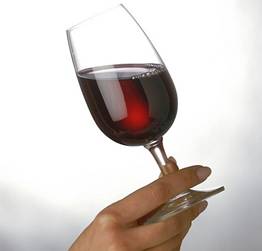
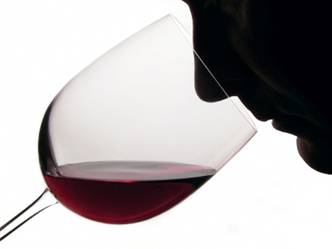
Before we began to taste, a brief lesson on how it is done properly. Pour into the glass, tilt it slightly, observe the colour and viscosity. Take three deep inhales and enjoy the aromatic bouquet. Then take a full mouthful so the wine touches all parts of the tongue, all the taste buds. Swallow and enjoy the finish.
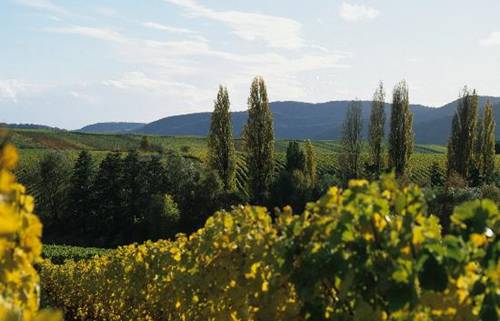
The first wine - Braun Grauburgunder Spätlese trocken (Pinot gris) 2008 - Qualitätswein mit Prädikat - comes from the Pfalz region in Germany, where sandy, clay, and coloured sandstone soils predominate. "Braun" is considered a modern next-generation German winery. This late-harvest wine has pronounced aromas of ripe mango and quince, as well as a long finish.
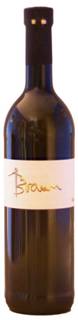
Iinuu's subjective verdict: The tangy quince flavour is clearly perceptible, very pleasant. Seems enjoyable both on its own and with food. I liked the bottle's ascetic yet elegant design - dark with a white label, the winery name written in handwriting. Of course, a surprise for everyone, including me, when opening it was the glass stopper. In the glass the wine visually resembles the colour of pale oil, good viscosity. 13% alcohol, although sipping it one would think there were fewer degrees.
Ēriks's associations:
I know that wines would be more properly classified either by flavour components or by use. I would like to introduce a somewhat different classification - by associations. This wine, for me, evokes the fullness of fruit and unambiguously autumn. Yet it is quite fresh and refreshing. As I see it, as it goes - the following scene came to mind: September, an Indian summer. Warm, but already an autumnal evening.
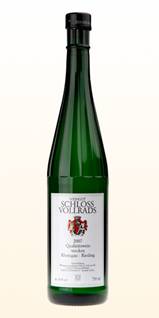
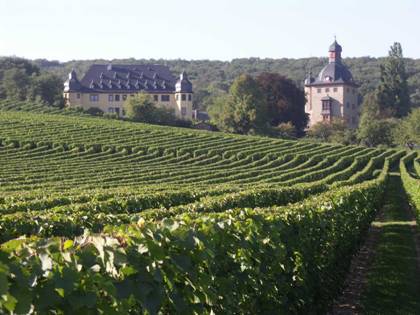
The next wine came from the Rheingau region - Schloss Vollrads Riesling Spätlese trocken 2007 - Prädikatwein (VDP), which we enjoyed from a glass specially designed for Riesling. It is slightly taller and narrower than a standard white wine glass. When sipping the wine, one must tilt the head back slightly more so that the wine touches the right taste buds and allows one to appreciate the true flavour bouquet.
A dry quality wine with a distinction mark. The harvest is gathered by hand, selecting small golden-yellow Riesling grapes. A dark green elongated bottle characteristic of Rieslings, with the vertically ribbed neck typical of this particular producer. Also with a glass stopper. :)
Iinuu: The wine's hue in the glass - pale straw yellow. I experienced it as heavier, more full-bodied than the first wine. Alongside, Larisa had prepared lovely snacks - smoked salmon with soft cheese and green salad. The food was excellent, but with that smoked salmon I would choose a slightly lighter Riesling in terms of flavour. The abundance of flavours was a slight distraction.
Ēriks:
A cold, frosty winter evening. February. A small town. The smell of wood smoke in the air. And somewhere there, in a warm little room, someone is sipping precisely this wine. :)
The third wine - Weingut von Racknitz Riesling trocken 2006 - Qualitätswein bestimmter Anbaugebiete (QbA) - from Grand Cru Riesling vine plots in the Nahe region. The base of the Klamm wine hill is volcanic rock, which imparts a special flavour character to the grapes growing there, as the soil contains porphyry and grey slate (don't even ask what those elements are). The vineyard is hollowed into the hillside like a parabolic mirror. The stones in the soil absorb the daytime heat to release it to the vines at night. The wine is enriched with an inimitable mineral aroma.
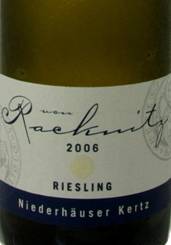
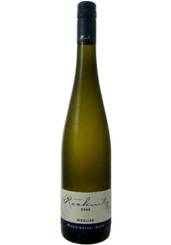
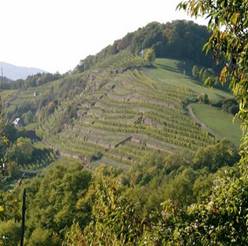
Iinuu: In the glass - golden with a barely noticeable olive-greenish tint. I must say, this wine was my favourite, whether I was influenced by the evocative story about the volcanic rock or not… The flavour was long-lasting, persistent, and evolving - quite different at the start compared to the finish that followed.
Ēriks:
Weeell, yesss… This wine genuinely surprised me. As you sip and roll the wine around in your mouth, after a while one gets the sensation that the wine has bubbles. Like very mineralised but "gone flat" water. Associations? Like sitting on the edge of a crater and sipping wine. :)
The fourth wine stood apart from the others in its green, flat and low bottle shape, characteristic specifically of wines from the Franken region. The bottle shape may have originated from the time when winemakers were monks and would take a wine flask with them when travelling. So - Schmitt's Kinder Silvaner Spatlese trocken 2005 - Qualitätswein mit Prädikat (VDP). The grapes grew in warm limestone soil. Some Silvaner vines are 25–30 years old. The flavour is rich with minerals, ripe apples, and piquant spice. Silvaner wine is more widely known as the true asparagus wine.
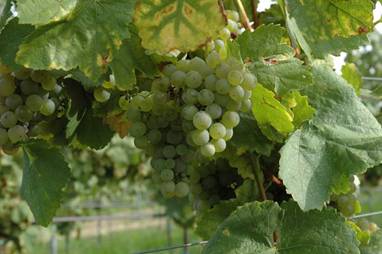
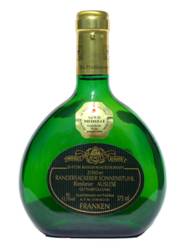
Iinuu: It tasted quite decent, but in a shop I would certainly walk past such a bottle without choosing it on account of its visual presentation. Apparently I am an incurable visual type, and being influenced by the wine's packaging, the wine's flavour itself failed to evoke the necessary feeling.
Ēriks:
Unambiguously - a spring wine. This feeling is probably created by the tangy bitterness. Yes, that is this wine's surprise - a tangy bitterness. Usually I have encountered a dry bitterness. Associations? Spring, the season of burning dry grass.
Unlike the others, the fifth wine was a red - Dr. Heger Mimus Spatburgunder trocken 2005 - Qualitätswein bestimmter Anbaugebiete (QbA) (VDP). It comes from the Baden region of Germany. The aroma carries redcurrants and black truffles with gentle spice notes (cloves and black pepper). Dark chocolate on the finish.
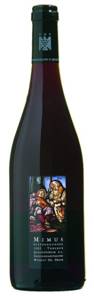
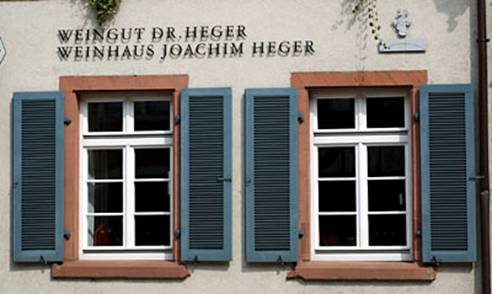
Iinuu: I am not a red wine enthusiast, but this one I genuinely liked. Moreover, alongside it came simply superb food - slices of Emmental and Edam cheese and quiche, about which I had previously known very little. Now, after browsing the internet, I found information that the dish originated in medieval Germany itself, where the practical Germans were reluctant to throw away the leftover dough from bread-baking and decided to bake a pie filled with pieces of smoked meat covered with a mixture of egg and sour cream. When the recipe drifted to France (it is now considered a French cuisine dish), the local cheese-making nation decided to enrich it with cheese and gave their own melodious name to this now perfected dish.
Classic quiche recipe: Mix 250 g flour, 125 g butter, 1 egg, and a pinch of salt with 3 tablespoons of cold water (some recipes use white wine), work into a dough, wrap in cling film, and refrigerate for a couple of hours. Cut 250 g bacon into cubes and blanch in boiling water for about 3 minutes, then drain through a sieve. Then melt a little butter in a pan and brown the bacon for about five minutes. Beat 3 eggs with 200 ml of heavy cream, add grated cheese, salt, pepper, and a little nutmeg. Preheat the oven to 200°C and grease the tin. Line the tin with the pastry rolled out to 3 to 5 mm thickness, raising an edge of about 3 cm high. Bake the pastry base for about 15 minutes, remove from the oven, and leave to cool. Then arrange the browned bacon on the pastry base and finally pour the egg and cream mixture over everything. Now bake the quiche for about another half an hour at medium temperature until it turns golden. Quite filling and very delicious.
Well then, it will have to be tried.
Ēriks: Sipping this wine I felt as if I were in an old house that most likely has an elderly owner. Crocheted doilies, old photographs, old furniture. A pendulum clock on the wall. Time passes but nothing changes. For the full picture one should try a few more Pinot Noir wines.
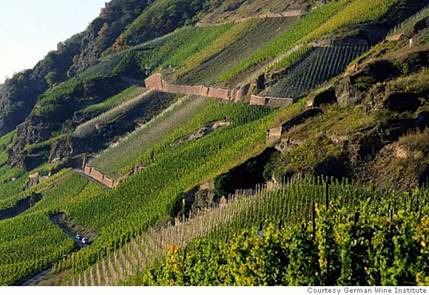
The final white dessert wine, as the closing note accentuating the evening's conclusion, comes from the Mosel/Saar/Ruwer region - Margarethenhof Weingut Weber Riesling Auslese 2005 - Qualitätswein mit Prädikat. An aromatic wine with an exotic fruit bouquet (grapefruit, apple, peach, apricot, mango, or quince). Riesling grapes - a speciality of the Mosel region in particular.
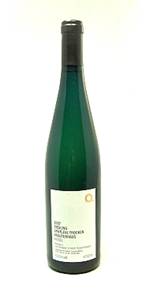
Iinuu: A greenish-blue, slender bottle, reminiscent of a sun-ripened full-sapped vine leaf. At the club there was talk that one could detect a petroleum-like aroma. I sensed nothing of the kind. For dessert - a French blue-mould cheese. Precisely this wine-and-cheese combination was simply ideal, with each one alone not quite to my taste. Paradoxical, isn't it?
Ēriks:
Although a dessert wine with a pleasantly sweet flavour, I must say that no associations arose at all. Somewhere there was a hint of rhubarb acidity in the aftertaste, but no visual scene came to mind. Perhaps drinking an entire bottle, the sweetness might prove cloying. An unusually large flavour difference between the wine character and the sweetness. Evidently the berries were harvested in late autumn. And here arose the challenge of trying ice wine, where the flavour contrast could be even greater.
Sources used:
http://www.hanzasvinagalerija.lv
http://www.kurzemes-vards.lv/?doc=31239
comments