Giacomo Puccini's "Madama Butterfly"
This Wednesday, 8 February, I watched at the LNO the widely known opera "Madama Butterfly" by Giacomo Puccini. Following - why this musical work and production touches the strings of the soul, but why this time it did not.
This Wednesday, 8 February, I watched at the LNO the widely known opera "Madama Butterfly" by Giacomo Puccini. Following - why this musical work and production touches the strings of the soul, but why this time it did not.
The libretto of the opera "Madama Butterfly" was written at G. Puccini's request by Luigi Illica and Giuseppe Giacosa, based on motifs from the Japanese drama "Geisha" written by David Belasco, who in turn borrowed them from the work of journalist John Luther Long. The opera's premiere took place on 17 February 1904 in Milan on the stage of Teatro alla Scala. Initially it was a story in 2 acts, but for the next staging at the "Grande" theatre in May it was reworked into 3 acts.
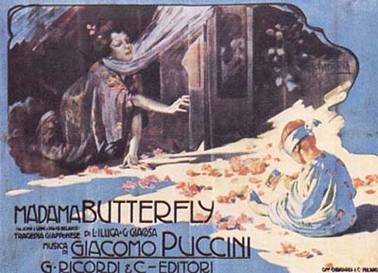
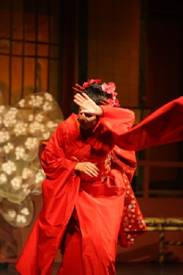
1904 poster & a scene from the LNO production today
In Latvia, "Madama Butterfly" experienced its premiere on the stage of the Latvian National Opera on 27 May 1925. Just as worldwide, so too in Latvia the staging underwent several revivals. The latest on 3 November 2006 under the direction of director Vladimir Okun'.
The Plot of "Madama Butterfly"
The action takes place in late 19th-century Japan, near the city of Nagasaki. American naval officer Pinkerton is captivated by the 15-year-old geisha Cho-Cho-San, who is nicknamed Butterfly by the people. The Japanese girl falls madly in love with the American and renounces her faith, relatives, and nationality to marry him.
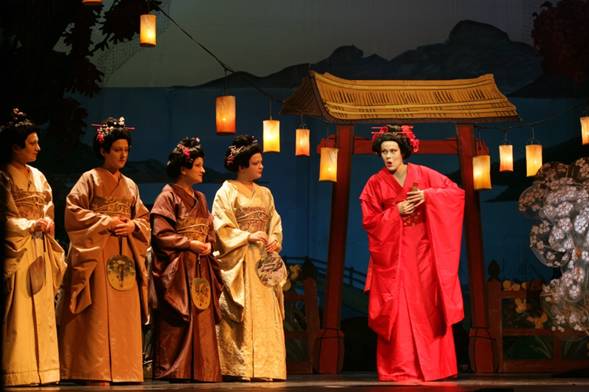
a scene from the LNO production
Pinkerton departs back to America shortly after the wedding. Cho-Cho-San waits patiently for three years for his return and does not believe the malicious gossip of people or their wise advice. With Butterfly are her faithful maid Suzuki and her little blond son.
Pinkerton, who has successfully married in America, learns from his friend that he has a son growing up in Japan. The officer returns to take the son from Cho-Cho-San and bring him to America to be raised. He himself is so cowardly that he does not come in person, but has everything arranged by his friend and his wife. Cho-Cho-San agrees to give up her son and takes her own life, saying "she dies with honour who can no longer live with honour."
About "Madama Butterfly" at the LNO
Beautiful, light-and-colour-rich stage design that in the imagination transports one to Japan of the past century. The reflection of the main character Cho-Cho-San's (Liene Kinča) inner experiences in the aria "Un bel di, vedremo" in Act 2 - and not the tragic finale - created the culmination. In my opinion, the finale - or more precisely the performance at the end - lacked that pang of grief which the story conveys as a whole.
The Butterfly aria "Un bel di, vedremo" performed by Maria Callas
I was perhaps too inspired by the introduction in the opera programme, in which a text by J. L. Long is placed: "She brought the tip of the weapon to the almost insensate place in the throat that every Japanese knows, and began slowly to press the blade into it; she could not hold on and let out a tiny moan. One could feel how the blood flowed down the throat: at the shoulder it divided, the larger stream flowing along the hollow of the throat. For a moment she even noticed how delicately it wound between her breasts."
The moment of Butterfly's departure in the LNO production was not convincing.
Sources used: wikipedia.org; images - opera.lv; 4u2find.blogspot.com.
comments