The Fundamentalist
To paraphrase a saying about many small happinesses, one could say - there is no such thing as one single truth; there are many small truths. I would like to apply this saying to the chamber production "The Fundamentalist" recently watched at the JRT.
To paraphrase a saying about many small happinesses, one could say - there is no such thing as one single truth; there are many small truths. I would like to apply this saying to the chamber production "The Fundamentalist" recently watched at the JRT.
Plot in brief:
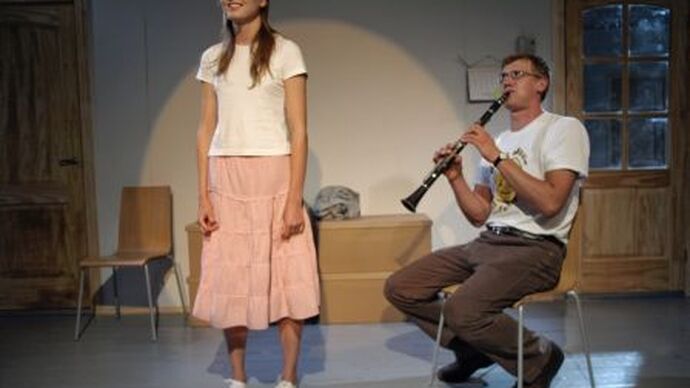
The production is about two people - a certain pastor named Marcus, who has served his congregation for decades and in his musings and life's trials has arrived at reflections on fundamental religion - Christian religion. And a simple girl, Heidi, who all her life had been searching for something great and sacramental. And found it too - in fundamental religion. The paths of these two people crossed for the first time at a camp where Marcus was the pastor and Heidi his assistant. Heidi was not a simple girl at all. She was active, full of the joy of life, but at the same time shy and confused. The paths of these two people diverged shortly after both arrived at a moment of intimacy at that same camp, which indicated an unmistakable coming together of both. For Heidi it was a powerful shock and she decided to flee. To flee physically, but not spiritually.
After ten years Heidi returned and, as one might guess, they had been thinking about each other all this time. True, that was already a different Heidi - one who had been soaked through to the core in fundamentalism and considered it her life's purpose to save her old acquaintance - the pastor Marcus - from perdition.
Heidi's knowledge and understanding of religion was more emotional. It rather served as a patch for the emptiness she had constantly wanted to fill. And she found it. A pseudo-patch, true, which after several years spent in love and euphoria began to wear through and the girl was again approaching yet another search for identity.
So she sought out Marcus. Marcus too over these years had grown in his reflections on religious matters and was actively musing about transforming the church, rejecting fundamentalism as the only cornerstone of the church's existence. But Heidi could not know this, and instead of receiving encouragement and support for her already cracking conviction in the historical truth of the Bible, she received an even greater shattering.
At the moment when Marcus gathered himself to say that he loves Heidi, and Heidi was ready to give herself in every sense of the word, she also understood that she no longer really knows what she wants, what she believes, or where her winding life path leads.
So Heidi decided to put an end to her suffering, but unsuccessfully, and ended up in a psychiatric hospital. So they met again and, as the pastor Marcus said - only by a fortunate coincidence is he the visitor and she the patient.
Reflections:
1. The entirely simple truth of this production (play) lies in the fact that Heidi was mentally ill (paranoid schizophrenia), and her behaviour can be explained by the course of this illness's development. And no religion need be sought here, because instead of religion it could have been anything - from demonstrating party loyalty to charity work.
2. If the above is ignored, there remains the old, good question about faith. Because if the historical truth of the Bible can already be doubted, what then is one really to believe in. Perhaps Christ was not crucified at all and all of it is invented? What then is the role of the church?
Without doubt, believing in something concrete (or not too concrete) is much simpler than believing in nothing. And it is quite simple to believe in something bad - the devil, for example. About the last one - well, how much is there to believe there...
In connection with this production many, many people have gotten up in arms about the fact that religion is being lumped together with faith. Indeed. I must say, it is hard to believe that these people are so entirely free from everything that associations between objects and phenomena have become foreign to them. But religion - no, that, you see, is bad and wrong.
3. A radical view - what faith (religion, obsession, etc.) can do to a person's psyche. Correctly - nothing! True, as long as it is the person's free choice. And who can forbid a person from being happy? At least for a moment... And do you think these people would be happier if their faith were taken from them? To live in reality... where is that? On the internet? In an urban environment where children up to a certain age believe that potatoes grow on RIMI shelves. And that is the reality you offer?
P.S. Not to believe in truth would mean to come into contradiction with oneself. To believe means to think that something is true. To say that there is no truth is rather foolish, because the very statement "there is no truth" is already a truth.
comments