3 April in World History
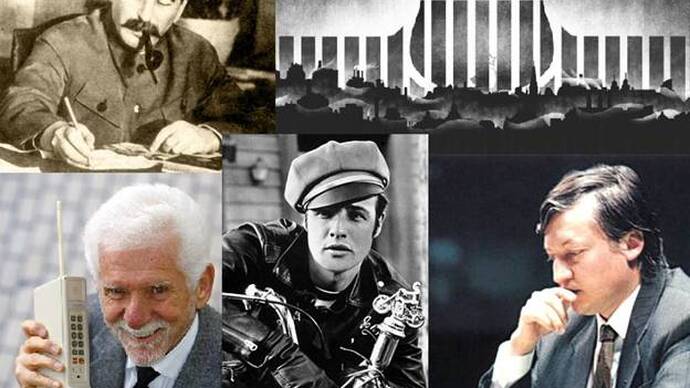
Today, on 3 April 2015, the Christian world commemorates Good Friday - the day of Christ's death and at the same time the day of the redemption of humanity's sins. But several other significant events have also taken place on this date - let us look back at history. For example, on 3 April 1973 in New York, USA, the first mobile phone call was made on a device developed by Motorola.
Today, 3 April 2015, the Christian world commemorates Good Friday - the day of Christ's death and at the same time the day of the redemption of humanity's sins. In the Roman Catholic Church, Good Friday is the only day of the year on which priests do not celebrate Holy Mass, and the faithful are required to observe strict fasting.
On 3 April 1922, Joseph Stalin was elected General Secretary of the Central Committee of the All-Union Communist Party (Bolsheviks). He held this position until 16 October 1952. To achieve his goals he employed mass repressions on a vast scale.
On 3 April 1948, US President Harry Truman signed the Marshall Plan, allocating USD 5 billion to 16 countries. It was a plan to support several European countries after the Second World War. The plan was proposed by US Secretary of State George Marshall, after whom it was named. When the plan concluded, every country that had received funds - with the exception of Germany - had recovered to the same economic level as before the war. The Soviet Union viewed this assistance as the United States' attempt to turn Western Europe into its sphere of influence.
On 3 April 1973, the first mobile phone call was made in New York, USA, on a device developed by Motorola.
On 3 April 1975, Anatoly Karpov was proclaimed World Chess Champion after Bobby Fischer refused to play him. He retained the title until 1985, when Garry Kasparov took over.
On 3 April 1924, American actor Marlon Brando was born. In the American Film Institute's list, Brando ranks fourth among the greatest male stars of all time. One of his most famous leading roles was in The Godfather, 1972.
comments