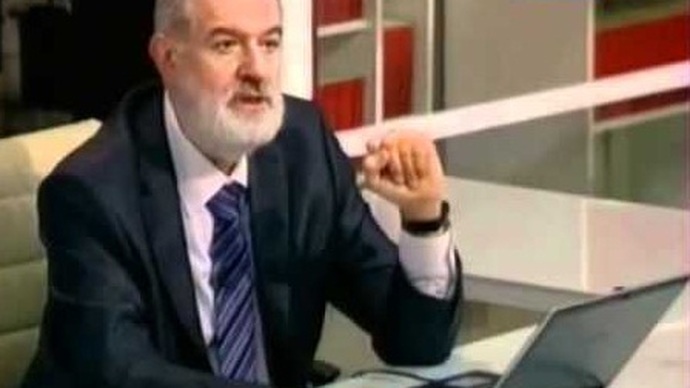
Leonid Matsikh's Lectures on Freemasons and the Role of Women in World History
We came across the lectures of Russian philosopher, theologian and philologist Leonid Matsikh in connection with the topic of Freemasonry. We watched the programmes with considerable pleasure, as the speaker is quite charismatic, with a rich command of language and well-formed views. Searching further for material from this wise man's lectures, we found two 2012 television programmes devoted to the role of women in shaping world history.
We first encountered the lectures of Russian philosopher, theologian and philologist Leonid Matsikh (1954–2012) in connection with the topic of Freemasonry. In 2011, the television channel «ВОТ!» produced a series of programmes (unfortunately left unfinished, as the speaker passed away) on the history of Freemasonry in Russia - Л. Мацих и А. Лушников «Вольные каменщики». We watched and listened to recordings of all thirteen episodes with considerable pleasure, as the speaker is quite charismatic, with a rich command of Russian and well-formed views on the vicissitudes of history, the role of the Enlightenment in European development, and a remarkable memory for facts, dates and names, as well as the ability to quote entire passages from works from memory.
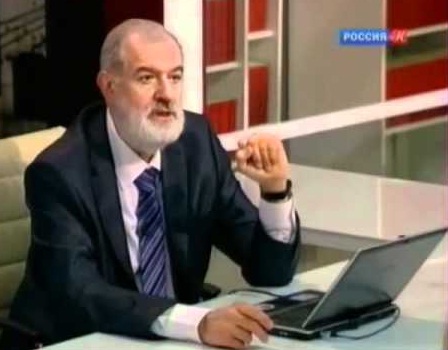 Searching further for material from this wise man's lectures, we found two 2012 television programmes devoted to the role of women in shaping world history - Леонид Мацих «Всемирная история женщин». Below I have attached the video material from these two lectures.
Why did the lecturer turn to this topic? Despite all the feminist victories of recent decades, our society is essentially patriarchal. The tone in society is set by men, and the dominant values are those postulated by men. Women, although they have achieved considerable success in the struggle for emancipation and equality, have not yet attained full equality. These two lectures by Leonid Matsikh tell the stories of the most remarkable women in human history.
Over the centuries, history has been written by men; only in the twentieth century are a few women - historians, artists, cultural figures, ethnographers - known to have participated in the process of writing history. For several centuries women were denied participation in the making of history, because history always takes place in the public sphere, while women were confined to the private, domestic sphere, which was closed to outsiders. Men did not admit women into the three main areas of public life - politics, religion, and the military - which are primarily the makers of history.
In these lectures I learned several interesting facts that are nowhere mentioned in historical records, because the historical turning points they describe were created by women, not men.
Eleanor of Aquitaine (1122–1204), wife of the Frankish king Louis VII, Countess of Aquitaine, Queen of France (1137–1152) and later Queen of England (1154–1189), was one of the wealthiest and most influential women in medieval Europe. She was the first to formulate a code of knightly conduct towards ladies and women. Poets celebrated her beauty in their works, and knights held tournaments in Eleanor's honour.
The innovation Eleanor of Aquitaine introduced during her lifetime and reign - and which we today take for granted - is the most powerful and uniquely female chess piece: the queen. At the time, chess was a live performance on a vast battlefield, with real horses and riders and participants dressed in appropriate costumes as the game pieces. Previously, beside the king stood his counsellor, the vizier - a male piece - but Eleanor proposed dressing this player in women's clothing and naming it the queen. This not only visually transformed the game pieces for all time, but also changed medieval thinking: a powerful queen beside the king, with the power to both protect the king and destroy him, and to influence the entire course of battle. Chess has been played by the world's greatest minds, men who write history and devise strategy - yet in this game there is now a female figure, and what a woman - a queen.
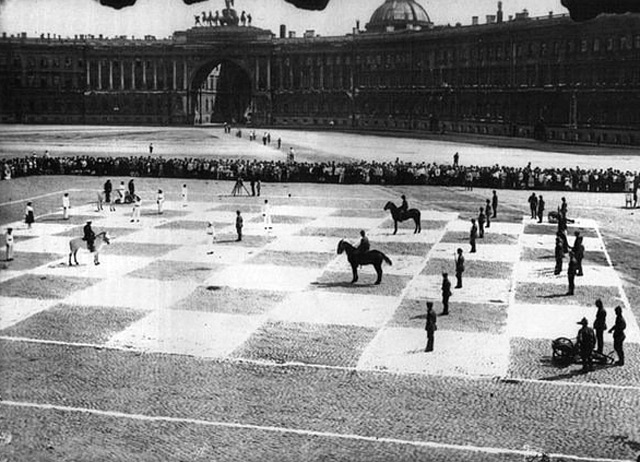
A scene from a live chess game in Palace Square, St. Petersburg, 1924 (still from the lecture)
Christine de Pizan (1364–1430) was the first woman writer in medieval French literature to earn her living through her writings. In practical terms she worked in a profession reserved for men, and her level of wisdom and learning was a match for any educated man of her time.
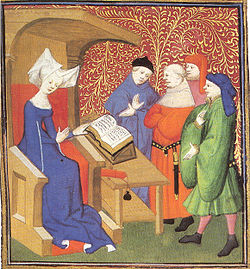 The image demonstrating Christine de Pizan's superiority shows her reading a book while seated, with all the men around her listening - standing. They represent a burgher, a nobleman, a monk and a merchant - representatives of all the most influential social strata of the time. Through her writings, Christine de Pizan proved that a woman differs from a man, but is not in the slightest inferior to him. A woman is a person in her own right, not a servant of a man's whims.
George Sand, or Amantine Aurore Lucile Dupin (1804–1876), was a French writer who first turned to feminism, and her name resounded not only throughout Europe but throughout the world. A woman who demonstratively dressed as a man, smoked cigars, and completely renounced all manner of cosmetics or jewellery. Her motto was: accept me as I am; I do not wish to pretend in order to please you.
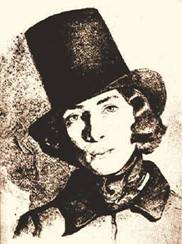 George Sand's works were read and admired by thousands. Her fees were no less than those of the great writers Dumas and Hugo of the time. George Sand's writings were translated into multiple world languages.
Other powerful personalities were also mentioned in the lectures. In conclusion, Leonid Matsikh also expressed his own position, in which he affirmed that he sees nothing good in the contemporary feminisation of society and in women sacrificing their family life for the sake of a career. For everything must be in balance; excesses in either direction lead to nothing good.
All in all, very interesting lectures with a lively perspective on things. One can only admire the lecturer's wealth of knowledge and his ability to present the narrative to an audience and captivate his listeners. I very much hope that the practice of open public lectures at universities in Riga (at least the University of Latvia has adopted this practice - we have attended them and found them worthwhile) will attract a wide audience and will also be recorded in video and posted online, in order to increase the educational level and critical thinking of Latvian society. For as things currently stand, the only freely available lectures online are in Russian or English.
comments