What Is a Lumpen?
Lumpen, or lumpenproletariat, derives from the German word Lumpen - rags, tatters. The term was introduced by K. Marx to denote the lowest strata of the proletariat. Later, all declassed elements (vagrants, paupers, criminal elements and other social outcasts) came to be called lumpen.
The word "lumpen" first truly appeared in media columns and in the public consciousness after the municipal elections of May 2013, when Harmony Centre (SC) came to power in Riga, having made free public transport tickets the central theme of their campaign. The artistic director of the New Riga Theatre, A. Hermanis, unable to contain his indignation, expressed two thoughts worth reflecting on:
"All right, I understand those poor Russians living in a schizophrenic state - geographically in one country, but mentally in quite another. But what is one to think of those Latvian ladies willing to give themselves for a tram ticket?"
"They have nothing to compare it to; they are poorly educated, have never travelled anywhere, have seen nothing. Why must we be hostages to a zombified lumpen mass?"
Lumpen
Lumpen, or lumpenproletariat, derives from the German word Lumpen - rags, tatters. The term was introduced by K. Marx to denote the lowest strata of the proletariat. Later, all declassed elements (vagrants, paupers, criminal elements and other social outcasts) came to be called lumpen. A lumpen is generally a person who owns no property, lives on earnings from casual labour, and often subsists on state social benefits in their various forms and manifestations.
Lumpen are declassed elements, people without social roots or a code of ethics - those ready to submit without objection to whoever holds power and authority.
Declassed elements in Soviet and post-Soviet sociology - members of society who belong to no social class. This category includes the unemployed, prisoners, the mentally ill, paupers, vagrants, prostitutes, etc.
Lumpen intelligentsia. The epithet was introduced by Russian poet A. Voznesensky to denote that portion of the Soviet intelligentsia who considered it necessary to step outside their social group, abandoning their previous occupation and replacing it with less skilled but better paid work, justifying this as social protest, opposition.
Lumpen bureaucracy (and others: lumpen-..., lumpen-democracy, lumpen-patriotism, etc.). The term is frequently used to criticise the political elite that emerged in the post-Soviet space. According to some publicists it is a derivative of the word "sovbourgeoisie," which arose after the 1917 revolution in Russia to denote officials who had "fattened themselves at the state trough" - those who perceive life and events around them as necessary and sufficient conditions for ensuring their own and their close ones' existence (for example, in L. Tolstoy's "War and Peace" there is justification that these are one and the same thing - author's note). A portion of society for whom pseudo-values and surrogates matter (hurrah-patriotism, the external enemy, etc.). In effect, such a lumpen elite reflects the values of lumpen voters.
Marginals
The word "marginal" derives from the Latin word margo - boundary. A person who is close to the boundary of the influence of various social groups, systems, cultures and contradictory norms, values, etc. (close to crossing the boundary).
A marginal group of people - one that rejects certain values and traditions and, in their place, establishes its own system of values.
Phonetically similar is the word "margin," which relates to profit - the difference between purchase price and selling price; the minimum, the lower boundary.
Despite their apparent similarity, these two concepts differ. A lumpen is someone who has fallen out of working and social life; a marginal is someone who has consciously stepped outside their social stratum but has not joined another.
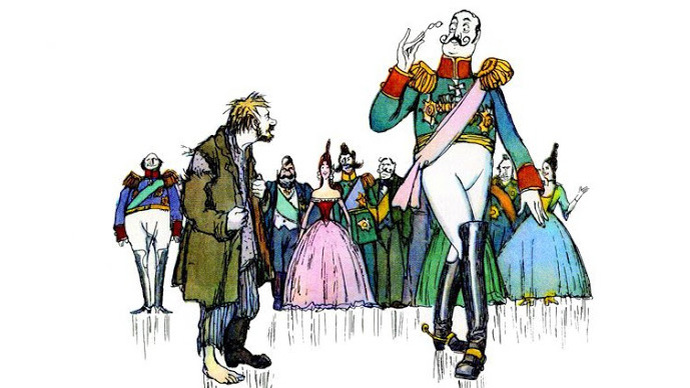
* The article uses a fragment from an illustration in N. Leskov's book "Lefty" (Левша).
comments