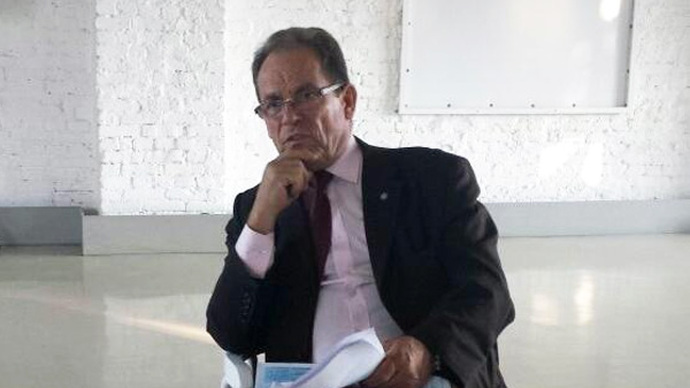
EP Elections. A Conversation with M. Šics (Latvian Regional Association)
Although the European Parliament elections are not those that will directly affect our (and your) lives, if there is an extra opportunity to choose the one you prefer, it is at least worth thinking about: a) whether to participate in the elections, b) if participating, then whom to vote for, and finally - c) if voting, then why for this particular party or candidate?
Although the European Parliament elections are not those that will directly affect our (and your) lives, if there is an extra opportunity to choose the one you prefer, it is at least worth thinking about: a) whether to participate in the elections, b) if participating, then whom to vote for, and finally - c) if voting, then why for this particular party or candidate?
When beginning to assess parties and candidates, so to speak "from a blank page", the first problem I encountered was that many candidates make unrealistic promises - raising pensions, providing free healthcare, etc. [1] These are all matters within the competence of the national government (or local authorities). I immediately crossed these empty promisers out of my notebook, because there is no point working with candidates who don't even understand what the European Parliament does.
Party programmes [2]. Fortunately, the programmes are short and readable. But as with any programme, it is only a programme, not an action plan. Even if the programme promises to address the minimum wage, it logically does not mention how and within what timeframe this is to be achieved.
Surely some politician's vision coincides with one's own, at least partially. That is the one to support.
-- Krišjānis Bušs
For me, one of the global goals is the community (neighbourhood) movement. This is a voluntary movement that can formulate a living space and form in quite an effective way and strive towards this goal. Community movements (historically) derive from social action - it is action that is independent of religion or politics.
Abstracting this goal, I began to look at party programmes through the prism of "People. Life and Living". Instead of that, I found in the programmes only - business, work, resource, etc.
EP Candidates
Since I live in a neighbourhood where this year only Harmony Centre came calling in political campaigning, I tried to follow the other "forces" on social networks. Unfortunately, when asking specific questions - for example about the free trade agreement, about GMOs - answers did not follow. Evidently the candidates adhere so closely to the PR script that they do not wish to spoil anything with an awkward answer. It is quite possible that these people also have no opinion and will rely on whichever crowd shouts loudest or donates most generously...
As it happens, I personally know EP candidates from both Vienotība and Harmony Centre. When the conversation turned to what the candidate would do once five years had passed, I learned two interesting things:
1. The vast majority risk nothing, since they mostly work in state or municipal institutions and for the period of their absence appoint a "duties-performer".
2. They do not plan to spend all their time in Brussels, only when necessary, which is very rarely.
Until one day, quite by chance on Facebook, I found out that Mārtiņš Šics was holding a meeting with voters.
Mārtiņš Šics
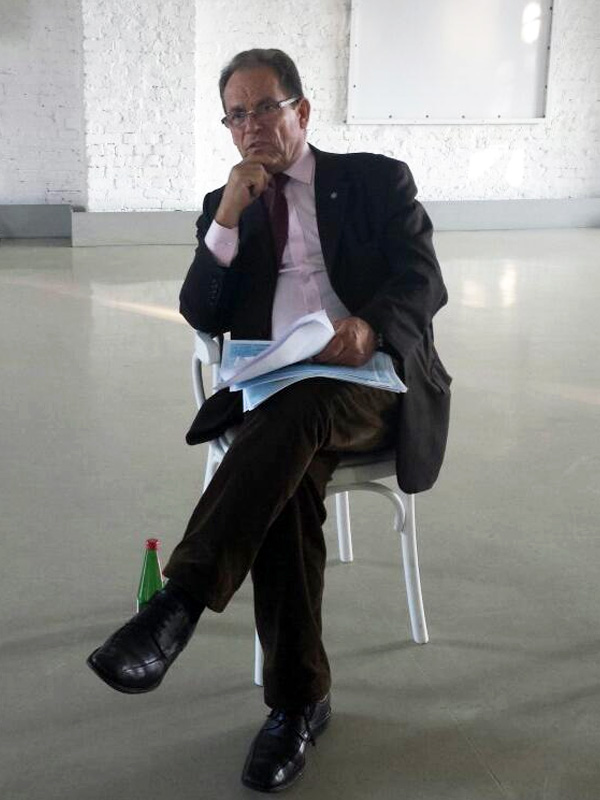
Photo: I. Brante.
(List No. 8, Latvian Regional Association)
Comparatively few interested parties had come to the meeting. A man of modest stature in his mature years began his address in a measured, slightly subdued voice. He had prepared carefully and studied statistics on social matters, as well as European data. The overall picture is what it is:
- Low purchasing power. Latvia is in second-to-last place, while, for example, in Austria purchasing power is 120%.
- The subsistence minimum provides for one pair of socks per year, one telephone every 15 years, etc. Needless to say, the warranty period (often also the service life) of a telephone is only 2 years.
- The population is ageing.
Šics is a medical doctor by training and has worked in this field his whole life. He did not hold back in discussing the curious and sometimes incomprehensible distribution of funding in this sector. He criticised the well-known tendency - in medicine, education and other sectors - to buy, buy, buy and the cheaper the better, regardless of quality and relegating people (and remuneration) to the last place, when it should be the other way around.
He touched on the refugee problem. Looking at the masses of refugees who, risking their lives, flee their home countries seeking refuge in Italy and Greece, we cannot continue to pretend this will not affect us. The refugee problem should be addressed in solidarity by all European states, Šics believes, but he also hastened to reassure that refugees from "warm countries" are unlikely to show interest in settling in comparatively cool Latvia. One may disagree with this, but what Šics pointed out aptly is that refugees are mostly from former French and English colonies - countries which have historically built their prosperity on the backs of slaves.
Šics's monologue gradually turned into a discussion and the conversation shifted to officials' over-zealousness in applying directives. Those present (evidently - entrepreneurs) hastened to point out that often the problem is not even in the laws, but in officials' idiosyncratic interpretation and attitude.
One could sense that Šics's strong points are social issues, including the ageing of the nation, negative population growth and the workforce. Interestingly, for a solution to the shortage of qualified labour, Šics encourages looking in the direction of India. The caste system prevailing in India allows only those belonging to higher castes to obtain an education and begin a working life in a foreign country. But as the most important point, Šics noted that immigration policy should be favourable towards countries which (due to cultural characteristics) are not inclined to form closed communities. Without naming them directly, one might think he was referring to Chinese and Russians.
Šics is pragmatic in his judgements, but in his vision I heard that note about people and living which at the beginning of the article I set as my goal in selecting candidates.
In Conclusion
One should not in general exaggerate the role of the EP elections. In terms of population, Latvia has only 0.4% of the total EU population. The EP represents 28 countries, with a total of 766 MEPs of whom Latvia has only 8.
An Estonian Master's student in political science, Karl Kase, has expressed himself quite bluntly [4] about the EP and democracy:
Person, if you know nothing about the European Parliament [...] please do not go to vote! Do not listen to cheap political propaganda that makes you feel significant because you participated in the elections. An irrational vote is many times worse than not participating in them.
Politics is not a 100-metre race won by the fastest (best). Estonian (and not only Estonian) politics is the most ordinary business, where the winner is the one with the best marketing department.
Sources:
[1] Unrealistic promises - to achieve EP increases in pensions, wages and benefits - http://www.tvnet.lv/zinas/latvija/510551-nerealie_solijumi_panakt_ep_pensiju_algu_un_pabalstu_pieaugumu
[2] Candidate lists for the European Parliament elections of 24 May 2014 - http://ep2014.cvk.lv/saraksti/
[3] Latvian Regional Association - http://ep2014.cvk.lv/saraksti/cf3fc39644.html
[4] Karl Kase: If you know nothing about politics, don't go to vote! -
in Estonian - http://www.delfi.ee/news/paevauudised/epvalimised/karl-kase-kui-sa-ei-tea-poliitikast-midagi-ara-mine-valima.d?id=68715455
in Russian (abridged version) - http://rus.delfi.ee/daily/epvalimised/magistrant-politologii-esli-ne-znaesh-o-politike-nichego-ne-hodi-na-vybory.d?id=68715455
comments