Friday Observation. Troy
Nowadays leaders do not need to inspire and persuade the people, do not need to be loved by the people. True, they need to be shrewd enough to attract financial resources, because as you can see, the devil himself dances for money, not to mention PR campaigns and international organisations. One way or another, Darwin's theory's requirement regarding resourcefulness must be met.
In the beginning there were no cities and people lived separately from one another, near sources of food. Depending on the climatic zone, they tilled the land, grew grain, kept domestic animals and otherwise prepared for winter. At least at our latitudes. But the sons of certain tribal fathers figured out that food could also be obtained more simply, though also more riskily - namely by taking by force from those who had something. The one and only principle of Darwin's theory operated: the strongest survive.
At the same time, at crossroads of waterways and roads, more densely populated places took shape. People could maintain smaller farms, because they could provide a livelihood for themselves and their family by serving sailors and travellers, in all the manifestations of that term. Thus cities arose and the "refined" Darwinian postulate came into force - namely that it is not the strongest who survive, but the most resourceful, those capable of adapting to different conditions.
Although people in cities lived considerably closer to one another, it is unlikely that they gave great consideration to each other's needs and wishes; however, in moments when some threat arose, whether a tribal attack or fire, people united and as best they could stood against the calamity.
Not everyone was equal, because some had better health, some sharpness of mind, some strength or endurance. In the crowd there were people whom the majority trusted. Thus leaders arose. Public deliberation was mostly limited to listening to the loudest voices, which was equated with the voice of the "majority". Freud's famous saying that the voice of intellect is quiet does not work at mass events. The loud voice, provided the message contains a simple and comprehensible logic, works on both large and small masses of people. The definition of the "loud voice" has changed somewhat to the present day, and its physical manifestation has been replaced by the intangible, such as the media (including social media).
Nowadays leaders do not need to inspire and persuade the people, do not need to be loved by the people. True, they need to be shrewd enough to attract financial resources, because as you can see, the devil himself dances for money, not to mention PR campaigns and international organisations. One way or another, Darwin's theory's requirement regarding resourcefulness must be met.
The Ideal World
But the ideal world is somewhat different. Although the concept of resource (strength, intellect, resourcefulness...) has not lost its significance and, it seems, will not do so quickly, the coexistence of different people becomes intertwined with social responsibility. Decisions are made collectively and responsibility too is collective (that is - none at all?). Every member of society ought to have the right to decide their own and their surroundings' future, to obtain full information about processes (to the degree each individual member of society is capable of understanding it). As a result, we arrive at a pyramid of trust, where every member of society trusts someone, up to the apex of the pyramid, where there is someone trusted by the majority of society.
Distorted Reality
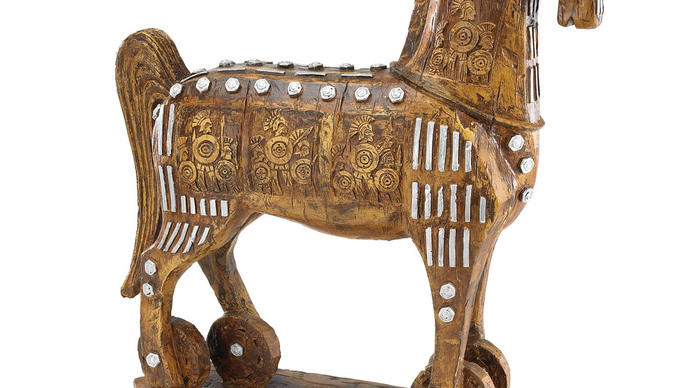
Unfortunately, the ideal world functions only in a closed society and environment. In it there is the lure of personal participation. But in reality there are surrogates - money, self-interest, vanity, a programmed inclination towards destruction. As a result, the figures of trust are no longer known to anyone, but their virtual presence, thanks to their personal prosperity, is everywhere. Collective participation (and later - responsibility) is limited to the selective screening of interested parties (for example, holding a public consultation in the middle of a working day, when the majority of active members of society cannot participate in it at all). Decisions about changes to the environment and infrastructure are made by people who do not live in that place. As a result, the Trojan horse is entirely real and we learn of it only after something has occurred that has ruined our own and our fellow citizens' lives. Then everything starts from the beginning again - we once more trust virtual people, a selective part of society makes decisions for which no one is later accountable. But in this scheme there is also someone who derives personal benefit from all of it, while society, the fool, identifies this as its own welfare.
comments