
Why Things Are the Way They Are
This morning I found myself wondering why Latvian society exhibits passivity when it comes to getting involved, expressing one's position in real action rather than online posts, taking on responsibility. From time to time an activist emerges. It is good that there is such a one, but that is not public opinion worth listening to, by whose demand or critical attitude it is worth reviewing norms or improving legislation.
This morning I found myself wondering why Latvian society exhibits passivity when it comes to getting involved, expressing one's position in real action rather than online posts or evading uncomfortable situations, taking on responsibility. Possibly one of the reasons is the children of the 1980s–90s, the young people who now make up the 30–40-year-old economically active core layer of the country's population. Those who, in the years of the National Awakening, received a large dose of postmodern culture in education, culture and the mass media, became intoxicated by it and now do not wish to change. It is comfortable, it is safe, it is stable.
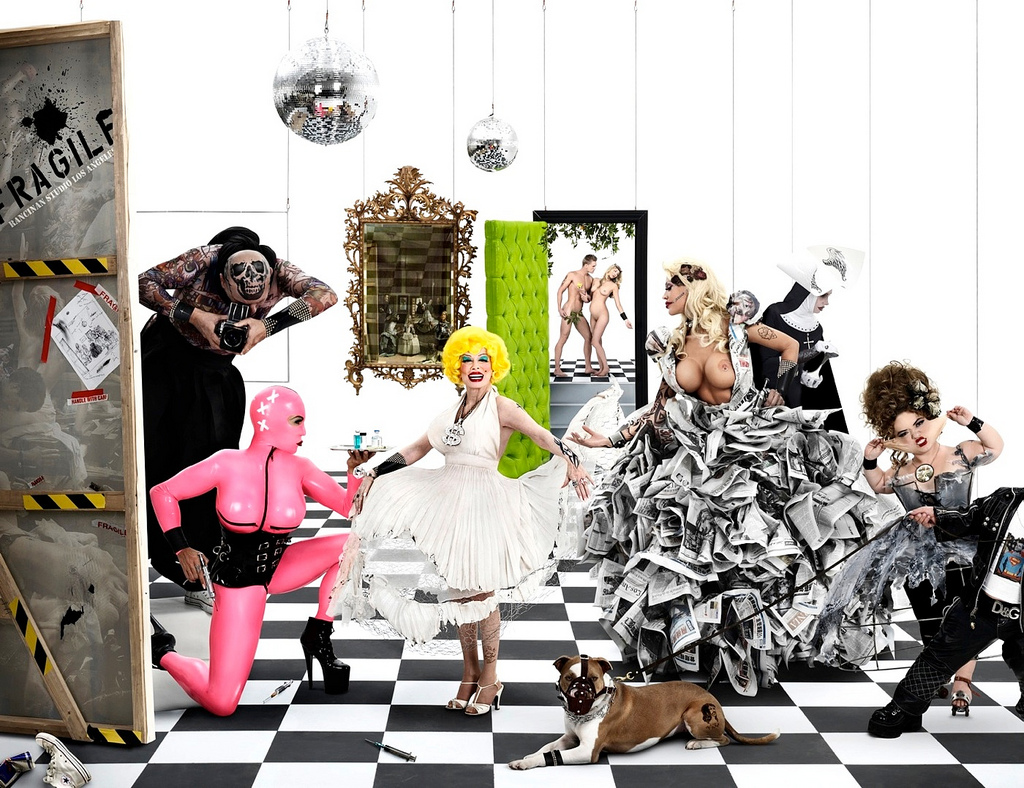
Gerard Rancinan - After Las Meninas (2009) – Photo by Cea, cc licence
Let us recall at least Guntars Godiņš - "The carousel turns. I sit aside, I do not participate. They call me, they beckon me, they call me a fool. I sit aside, I do not participate. [...] I am like a tree or a grave outside the fence and of Non-Being. I do not participate. I am dangerous." In the nineties this was at the top. The individual, in contrast to the Soviet era's all-powerful collectivisation and mobilisation (no member of society was permitted to be without an official job), suddenly allows himself to be passive, a silent one, merely an observer. He may not even have his own firmly formulated convictions.
The majority are happy to accept the rules of the game that George Orwell postulates in his novel "Animal Farm": "All animals are equal, but some animals are more equal than others." No one raises questions about the man of power who, foaming at the mouth, urges people to adopt the lifestyle of a cyclist or to use public transport to get to and from work, while himself getting around central Riga in a 6-litre engine car every day.
From time to time an activist emerges who begins going around to public consultations, writes long epistles to state institutions, reports violations of the peace, noise or odour regulations, collects signatures, paints park benches at weekends. It is good that there is such a one, but that is not public opinion worth listening to, by whose demand or critical attitude it is worth reviewing norms or improving legislation. There is a Kurt Vonnegut quote: "There is no reason why good cannot triumph over evil, if only angels would get organised along the lines of the Mafia."
comments