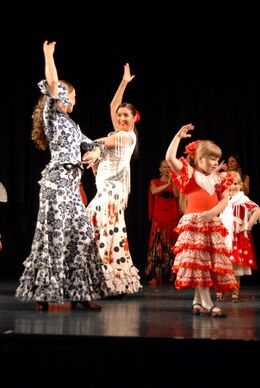
Yesterday, on 17 April, the hall of the Riga Congress Centre resounded with vibrant Spanish rhythms. Energy flowed from every movement of the dancers, the flamenco musicians, and the singers. A powerful wave of vitality swept over all the audience members, who with every performance followed what was happening on stage with ever-increasing liveliness, applause, and cries of delight.
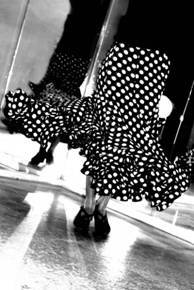
I want to share a positive experience of ordering flamenco dance skirts from Spain. As a result I saved both time and money, and within a month received the desired item. On 9 February this year I ordered dance skirts from the www.flamencista.com website, and on 10 March I received a notification from Latvian Post that I needed to collect a parcel.
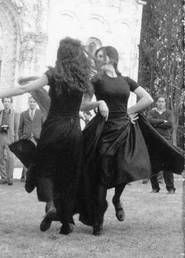
Pizzica is an appealing, highly rhythmic, and "catchy" Italian music and dance. I first heard pizzica in the art film Ne Te Retourne Pas (2009), starring two wonderful actresses Monica Bellucci and Sophie Marceau, when the heroine Jeanne, trying to remember her past and find herself, entered an Italian home where a celebration was taking place. Initially the dance was like a flirtation between an unknown man and woman, later transforming into a dance of rivalry between two women. Looking it up online and reading descriptions of the dance, it turns out this short film fragment captured the essence of the dance very well.
At the Almost Theatre Artelis on Monday evening - 22 November at 19:00 - in collaboration with the flamenco dance club Duende, a flamenco evening was held. The venue must be said to be ideal for such an evening - I cannot imagine a better one in Riga. One could enjoy Marianna's nimble dance steps and Agustin's velvety voice timbre.
Viewed through the flamenco family tree, tangos originated mainly from the Romani music branch. This accounts for the sharp, accented movements, the strident sound, and the performance's focus on rhythm rather than melodic quality. The song or dance usually begins with clapping in the above-mentioned rhythm and continues throughout the entire performance, accentuating moments of climax and relaxation.
From 26 to 29 August, the annual summer camp organised by the flamenco dance studio DUENDE took place in Zvejniekciems, with an opportunity for all studio dancers to gather together and learn from guest teachers - flamenco instructors from Spain. I took the opportunity to attend two days of compas classes with percussionist Andrej Vujicic, as well as tangos and alegrias dance technique with flamenco dancer Francesca Grimm.
This year we visited Madona for the third summer running, where the Exotic Dance Festival took place on the afternoon of 31 July at the culture house. It must be said that with each year the event becomes more organised, more varied, and better attended. Alongside the traditional belly dance choreographies such as oriental, saidi, and tribal, original pieces and fusions of various styles were on display. Several Gypsy dance performances and improvisations with Spanish, Moroccan, Brazilian, and Indian dance styles.
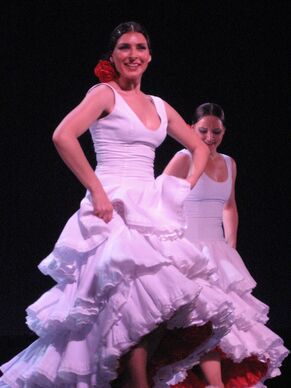
Yesterday in the hall of the independent Riga theatre "Skatuve", the annual end-of-year concert of the flamenco dance club Duende took place. Various flamenco styles were danced on stage - tangos, farrukas, sevillanas, alegrias, tanguillo, bulerias. The performances were made more splendid not only by the variety of brightly coloured costumes, good dance technique, and the dancers' emotional engagement, but also by various dance accessories - castanets, fans, hats.
Bodies interweave, hurried steps pass by, endlessly past through puddles, glances that casually notice nothing. Am I alone in this city, in this world, or is there always someone watching over me? Some inner force, some light that allows the chrysalis to be reborn as a butterfly. That too can be called God. When you have found it within yourself, fallen in love with yourself, then you can lift your eyes to another and fall in love with God in the other person. Butterflies are drawn to the light, people to love.
Sevillanas is the first of the flamenco dance styles I have started to learn at the Spanish dance club Duende. Of course, one must start from the most basic movements - learning posture, arm movements, counting the rhythm, and then the steps. Classes take place in small groups, which is beneficial in that dance teacher Ilvija can give individual attention to each person, correct mistakes, and monitor the execution. The hour allocated to each class passes unnoticed. What follows is a little about sevillanas itself.
.jpg?w=690&mode=16x9|crop)