Kizomba, Salsa, Reggaeton, Bachata - First Steps
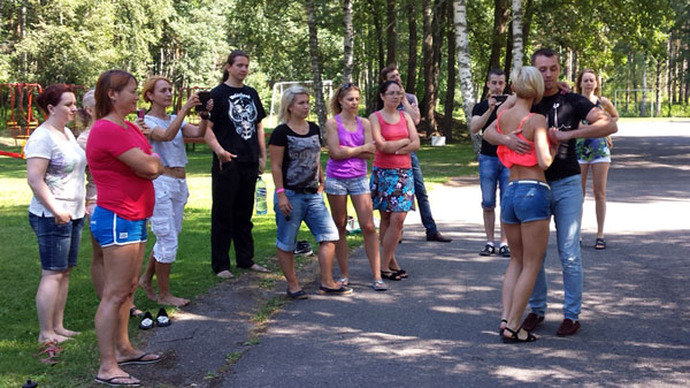
Beginners were lucky, as the classes took place under the open sky, on a sun-drenched lawn, with the option of dancing barefoot - the latter mainly to avoid treading on a partner's toes. The atmosphere was very relaxed, and a beginner with no experience didn't feel in any way excluded or critically judged. Even if in some classes there wasn't much to learn, they still gave a small taste of the dances themselves.
The information about beginner classes came completely by chance - a post on the Facebook SalsaLovers wall (and I hadn't even followed them before, zero prior knowledge). The decision was made immediately - I emailed the event organiser Anna saying I wanted to give it a try. The venue (Munchausen Unda, Saulkrasti), the time (Saturday, 19 July, from 11:30–19:30, with a lunch break and the option of sunbathing by the sea), and the catchy dance names caught my attention - along with the note that those who have never danced these dances are welcome to try.
No sooner said than done. Saturday morning I got in the car and headed to Saulkrasti. The day was simply wonderful - sun, sea, a pleasant breeze. When I arrived at the hotel grounds, I found that a whole event was underway - Salsa Summer Splash Riga - with dancers and dance teachers of various levels having arrived from different countries. Masterclasses were taking place in three halls over three days in a row. Over 100 dance enthusiasts in total.
Beginners were lucky, as the classes took place under the open sky, on a sun-drenched lawn, with the option of dancing barefoot - the latter mainly to avoid treading on a partner's toes. It was also a pleasant surprise that there were many men among those wanting to dance (including about three beginners who had come to the classes independently). Everyone was paired up, with partners constantly being rotated to practise the dance steps. As I understood, dancers from the SalsaLovers school had come to assist.
The classes were conducted primarily in Russian, as the majority of participants were Russian speakers. Only the last class was in English, as the teacher Franco - judging by his dark brown complexion - had evidently come from some southern country. The final dance lesson, during which we learned the basic steps of bachata, was led by him. But let's take things in order.
Kizomba
The first dance - kizomba - classes were led by Andrejs and Oksana. First the steps were taught to the girls' group and the boys' group separately, then in pairs. This dance appears to have no strictly defined figures; it reminded me of constant walking with, around, and alongside the partner - the hands are not the leading element here, and direction is determined by turning the body a certain way. Beautiful, but from a beginner's position, rather difficult to grasp.
Kizomba - a dance style that originated in Angola (a country in southern Africa) in the early 1980s. Unlike fast and rhythmic African music, this dance has less dynamism, greater fluidity, and romanticism. Songs with a kizomba rhythm are usually performed in Portuguese.
Salsa
Second was the salsa lesson, led by Anna. She taught three dance steps very simply, and when danced with a partner it already looked like a real dance. Direction here is determined by the hands, the distance between partners is more distanced, and the steps are wider. I felt that this dance has more freedom, and the step pattern is also easier to grasp.
Salsa - a dance from Latin America that developed in Cuba in the 1970s. It can be danced in pairs or in a circle, rotating partners. Salsa has many and varied styles, influenced by its wide geographic spread - Cuban style, Colombian style, Venezuelan (Dominican) style, New York style, Puerto Rican style, etc.
Reggaeton
After a swim in the sea, the classes continued with a reggaeton lesson, again led by Anna. Whereas the previous dances were tinged with romance, sexuality, and subtle eroticism, this one was rather aggressive and - as the teacher herself remarked with a laugh - even "pornographic". A fast and very clear rhythm, energetic and broad movements (hard even to imagine how this can be danced as a couple), with an edge of aggression.
Reggaeton - comes from Panama (a country in Central America), flourished in the early 1990s under the influence of Jamaican reggae, with something of techno, rap, and also traditional Puerto Rican music. The music is usually sung in Spanish.
Bachata
The final class - the basic steps of bachata. Franco was in no hurry to teach choreography, as the main thing is to master one basic step with a couple of variations, and you can dance all evening. But the key is to dance that step correctly. So for the whole lesson we "drilled" this step in pairs, until something finally started coming together.
Bachata - a dance from the Dominican Republic (the Caribbean region). It does not have the same pronounced ornamental figures as salsa, but similarly, leading the partner in the dance is done with the hands. The rhythms vary from gently melodic to fairly fast. It is usually sung in Spanish.
Looking back on it now, with a feeling of satisfaction and pleasant muscle soreness in the legs and lower back, last Saturday was a well-spent day - dancing under the open sky, practically by the sea. The atmosphere was very relaxed, and a beginner with no experience didn't feel in any way excluded or critically judged. Even if in some classes there wasn't much to learn, they still gave a small taste of the dances themselves. It's quite possible I'm hooked on a few of these dances again.
comments