
Interesting Facts About Dreams and Their Interpretation
There are dreams we simply don't remember, and we even falsely claim that we didn't dream last night. Everyone dreams, even blind people who during the day see neither concrete images nor colours. But there are dreams that surprise us, frighten us, move us, and regardless of how superstitious you are or aren't, compel you the next day to look for a dream dictionary on your shelf or most likely to search for one on google.com.
There are dreams we simply don't remember, and we even falsely claim that we didn't dream last night. Everyone dreams, even blind people who during the day see neither concrete images nor colours. But there are dreams that surprise us, frighten us, move us, and regardless of how superstitious you are or aren't, compel you the next day to look for a dream dictionary on your shelf or most likely to search for one on google.com.


Photo from (source)
On one hand this is a positive thing, because you are trying to explore yourself and your visions, to better understand what is really brewing in the pot of your brain. Perhaps in this way you even find a solution to some long-entrenched problem, as scientists not without reason claim that when the human body rests, brain activity doubles. Interestingly, there are even studies showing that the number of calories burned while sleeping in the dreaming phase is greater than when spending the same time awake sitting in front of the television. It is possible that a dream points to the cause of a problem or shows a thread towards its resolution.
On the other hand, with so many diverse theories having passed over dream research up to the present day - psychoanalysis, the dream interpretations of S. Freud and C. G. Jung - one can assert that all the so-called dream interpretation dictionaries are complete nonsense. Every person's dream is deeply subjective. One and the same vision, object, or situation means to one person, for example, something foreboding - illness, loss, or similar - while to another it is merely changes in life that ultimately bring something good and long-awaited.
Whatever the case, dreaming remains a territory not yet fully explored, which has always attracted researchers, scientists, psychologists, astrologers, healers, and each of us. Small wonder, given that we spend at least a third of our lives dreaming.
An attempt to interpret and in some way systematise (which people enjoy doing enormously) dreams was made in the 2nd century AD, when the Greek philosopher Artemidorus (Ἀρτεμίδωρος ο Δαλδιανός) wrote the book "Oneirocritica" in 5 volumes. He compiled more than 3,000 dream interpretations. The first edition of this book was published in Greek in Venice in 1518; it was later translated and republished in Latin.


The 1518 edition of "Oneirocritica" & the Latin edition
There were written records of dream interpretation even before Artemidorus and in the pre-Christian era, but in the "Oneirocritica" the author did not limit himself to the appearance in dreams of things or phenomena commonly encountered in the society of that time. He collected information and adapted it to the dreamer according to their occupation, lifestyle, social class, and also gender. Not without reason, the well-founded differences between men's and women's dreams are also discussed today.
Oneiros - Ancient Greek for "dream" - and from this name also comes the name of the science that studies dreams: oneirology. Exploring sources in Latvian, there is almost nothing about it, unlike what has been written in English and Russian. In brief: oneirology links the dreaming process - which consists of separate so-called "rapid sleep" (REM) phases (lasting approximately 20 minutes and recurring every one or two hours) - with the rapid movement of eyes beneath the eyelids. Thus, by observing someone who has fallen asleep, one can easily tell when they are dreaming. Moreover, during the dream phase, a person's pulse quickens and breathing becomes irregular. Complete bodily paralysis also occurs, a freezing of the body.
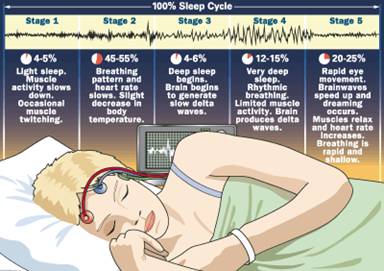
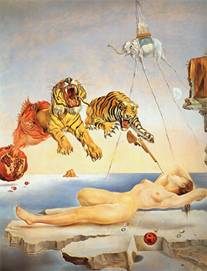
Sleep stages (source) & Dalí's painting "Dream Caused by a Bee Flying Around a Pomegranate a Second Before Awakening" (1944)
That last sensation has presumably been caught and felt by many people (I have at least experienced it myself, and some friends have confessed to me, told me about it). At the moment when something (a noise, a touch, etc.) abruptly wakes you during a REM phase, the mind seemingly wakes but the body is still paralysed. I can honestly say - it can give you a real fright.
Mystics also call this paralysis the small death of the body, when a person seemingly balances between this world and the other. Moreover, in recent years, with new speculations about the nature of reality appearing alongside films such as "The Matrix" (1999), "Inception" (2010), and others, dreaming and waking acquire a new meaning. The provocative question is posed - could our familiar reality be merely one of the levels of a dream?
Then finally, one arrives at the question of lucid dreaming and controlling dreams (also one of the things people very much enjoy doing). I remember my mother used to tell how during her student years in Soviet times (that was in the 1970s) in Riga, experiments were conducted where only invited students were asked to sleep in a laboratory while their sleep was studied, and there was also talk of acquiring knowledge and foreign languages in a sleep state. Interesting - are any similar studies being conducted now?
I am not convinced that consciously influencing a dream is a good thing, though it can yield positive results in a person's real life. I am more inclined to agree with the suggestion to record, write down your dreams - in this way understanding them better and perhaps even discovering certain episodes that recur constantly and point to something significant in a person's life.
comments