About the Entrepreneur Who Became Rich
Once there lived a fictional character - Jānītis. One day Jānītis was made redundant from a state institution job and without much hesitation decided to set up his own company. Drawing on savings accumulated from his civil service work, after nearly a month Jānītis had established his own company.
Once there lived a fictional character - Jānītis. One day Jānītis was made redundant from a state institution job and without much hesitation decided to set up his own company. Drawing on savings accumulated from his civil service work, after nearly a month Jānītis had established his own company.
In the company, Jānītis was the only person. Both accountant and boss and employee. The company was in the business of snow clearing. In the first month things went well and at 45 lats per day, working 8 hours a day throughout the whole month, Jānītis earned 1,000 lats. Naturally, issuing receipts to all clients and at the end of the month honestly paying his taxes. In the evenings until late at night, Jānītis took care of documents, contracts and orders as best as his conscience allowed.
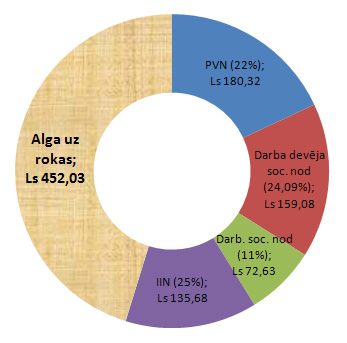
The next month arrived and the long-awaited payday. From the 1,000 lats earned, Jānītis paid the state VAT - 180 lats, employer (159 lats) and employee (72 lats) social security tax and personal income tax (135 lats). As a result, only 452 lats remained for the salary.
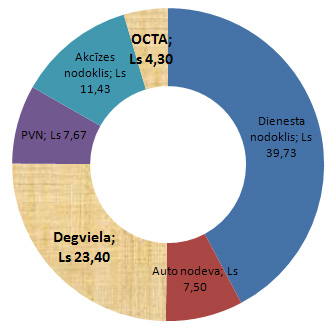
Since Jānītis's work involved driving to clients, he had owned a car even since his civil service days, which, being an honest citizen, he registered as a company asset. There was also a registered address - true, a shed arranged through a friend (where to store snow shovels) with a letterbox. Jānītis was not wealthy; he lived in Sarkandaugava, while finding an affordable office near his home proved impossible. He found one in Pļavnieki. To travel from home to the office by public transport required 3 connections and a total travel time of more than an hour, and in winter sometimes two hours. So Jānītis decided to use the car for private purposes too, accordingly agreeing to pay the company car tax - 40 lats/month.
Although the car was quite large and spacious, Jānītis drove economically. Spending only 50 litres of petrol per month, which since 1 January 2011 cost 42.5 lats (0.85 lats/litre). There was also compulsory third-party liability insurance (4.3 lats/month), technical inspection and vehicle duty at 7.5 lats/month. Altogether this cost 94 lats.
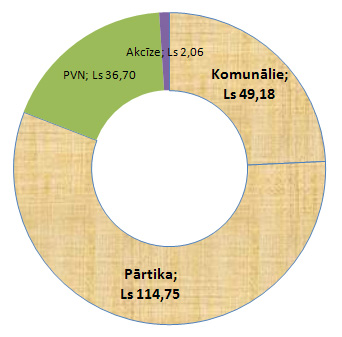
Being a manual worker, Jānītis spent 140 lats on food, treating himself to 2 bottles of wine and 2 kg of coffee. Jānītis did not eat lunch in cafes; he brought it from home. Jānītis was fortunate with his flat, as he had inherited it from his parents. So all that remained was to pay the utility bills, which on average were 60 lats per month. In total, 200 lats were spent on living expenses.
After all these expenditures, Jānītis had a whole 155 lats left over, to spend on car repairs, the purchase of work tools, medications, books and clothing.
Jānītis is proper - doesn't smoke, doesn't drink spirits, doesn't bring girls home or take them to pubs. He has no internet or TV; cable television he cannot afford, and the TV aerial in the days of analogue broadcasting barely picked up Latvian channels, let alone now when an additional decoder must be purchased. No internet either, and no computer. True, he does buy the odd newspaper. Jānītis is young and rarely gets ill. Being the only employee, he could not afford to be ill either.
So it came to pass that Jānītis had read that the wise gentlemen in the Saeima were deliberating that those earning more than 500 lats would count as wealthy and their large salary would be taxed additionally. At least his salary came out to under 500 lats.
The dry summary.
As money passes through one full cycle in taxes (VAT, excise and duties), 65% is paid and only 35% remains in hand. In the next cycle only 12%, and so on until all the money returns to the state budget.
comments