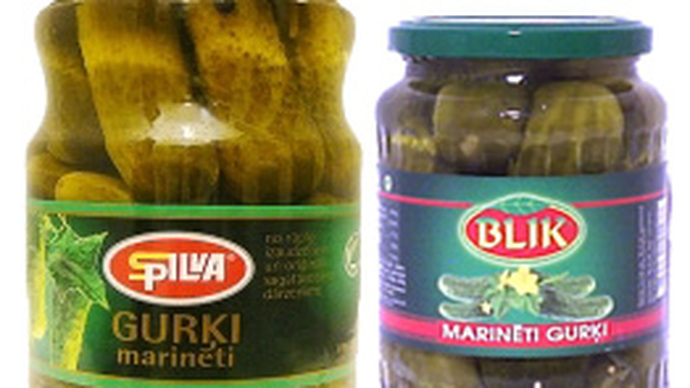
It Turns Out Latvia's Little Cucumber Isn't Latvian at All :(
Hmm.. it turns out butter has also long since not been butter, but a butter spread; cream - a cream product. That, it seems, no longer surprises anyone. Latvian sugar, too, will soon no longer be Latvian sugar..
Quite by chance I came across an article on apollo.lv [1] about cucumbers manufactured in Latvia which are in reality not made in Latvia, but in India, Turkey and goodness knows where else. I felt the urge to write down my own thoughts on this matter.
Hmm.. it turns out butter has also long since not been butter, but a butter spread; cream - a cream product. That, it seems, no longer surprises anyone. Only don't tell me you hadn't noticed? :)
Clarity came from a conversation with a well-known food wholesaler. It turns out cucumbers and many other vegetables do not fail to grow in Latvia - rather, Latvian folk cannot provide them in sufficient quantity. Of course, organising cucumber growing is not the same as managing an n-million-worth power plant or bridge. :) Is Europe to blame?
Of course, there are things that also genuinely do not grow in Latvia. For example - pickled peppers, nuts and so on sold under a Latvian trademark.
Speaking of those little cucumbers, the greatest surprise is caused by the fact that the jars have the "Green Spoon" staring out from them, which, at least in my consciousness, has lodged itself as a guarantee that the product is made in Latvia. But is it?
The "Green Spoon" mark is awarded to food products in which at least 75% of the raw materials obtained in Latvia are used and which meet the necessary quality requirements, as confirmed by the relevant certification body. [2]
The "Green Spoon" is objected to by the EU. That is also partly understandable, because by highlighting the country of manufacture (in this case - Latvia), the sales of producers from other countries are restricted.
The minister (Mārtiņš Roze) is also convinced that, by slightly transforming the conditions for obtaining the Green Spoon, the Marketing Council should continue its work on food product quality control and public information. M. Roze acknowledges that the Green Spoon is one of the most successful marketing projects in Latvia. Thanks to the work of the Marketing Council, our consumers are informed about good and quality products. [2]
It is interesting, however, that the ministry itself frames the "Green Spoon" as a marketing product, placing quality in a secondary position.
About Sugar
On 27 November 2007, the Competition Council adopted a decision permitting the merger of AS Danisco Sugar and AS Jelgavas Cukurfabrika, which was planned through AS Danisco Sugar acquiring the assets of AS Jelgavas Cukurfabrika, including the trademark Jelgavas cukurs (Jelgava Sugar). [3]
Which, both theoretically and practically, means one thing - in the old packaging there will be not the Jelgava or Liepāja sugar "caught in the warehouse", but a Danish product.
A muddle with trademarks (brands) can also be observed with other products - for example, "Limbažu piens" (Limbaži milk) is produced by the Riga Dairy Plant, while the Cēsu alus (Cēsis beer) in cans is brewed in Estonia.
1. http://apollo.lv/portal/news/74/articles/129099
2. http://www.zm.gov.lv/index.php?id=2247&sadala=830
3. http://www.db.lv/Default2.aspx?ArticleID=85fbb59f-0cfa-4515-a7b3-717e532bd058
4. http://www.tvnet.lv/onlinetv/lnt/balss/article.php?id=300424
comments