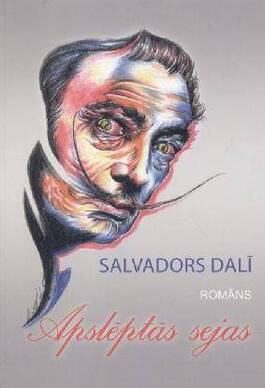
Salvador Dalí "Hidden Faces"
I have just read the only novel by the Catalan artist and Surrealist Salvador Dalí, "Hidden Faces" (published in Latvian, 2011). He "paints" every smallest detail in nature, in the expressions of a human face, in associations and in the waking dreams characteristic of the author, using a fine, high-quality brush (so as not to smudge).
I have just read the only novel by the Catalan artist and Surrealist Salvador Dalí, "Hidden Faces" (published in Latvian, 2011). For anyone interested in art and literature this is inevitable, since as the author himself announces in the very first sentence of the book: "Everyone, sooner or later, will fatally encounter me."
 The language - practically not a single simple extended sentence, only compound coordinate and compound subordinate clauses, each with yet another 3–4 subordinate clauses. Unceasing visual images, associations, comparisons. As if not writing but painting with words. He "paints" every smallest detail in nature, in the expressions of a human face, in associations and in the waking dreams characteristic of the author, using a fine, high-quality brush (so as not to smudge). At first it was somewhat difficult, as reading demanded undivided attention to grasp the thought fully - but then it swept me away.
The novel tells of the fates of French aristocrats during a difficult period for Europe, spanning from 1934 to 1945. At its centre are the moral sufferings of individuals, the shift in the value paradigm of society during the war and post-war years, and love and passions capable of sacrificing everything - ranging from fragilely romantic and barely tangible to eroticised and even perverse.
"Hidden Faces" is a fitting title, for it is precisely this donning of the mask (both in the literal and figurative sense) that plays the fateful role in the relationships of several couples. The extraordinary interplay between the novel's main protagonists - Count Hervé Grandsailles and Solange de Cléda - as well as the principles and ambition of both, are what prevents them from remaining together and leads to Solange's demise. Neither is ready to fully reveal their true face, their true feelings and intentions.
Dalí astutely characterises pre-war French aristocratic society with the quotation: "No one made plans any more: they rose late so as not to awaken the stiffened wings of ambition, and were delayed in going to bed so as not to awaken the voice of conscience."
"Boredom combined with fear becomes a dangerous force."
Dalí has always been drawn to extraordinary, great personalities - the benevolent and the malevolent genius - which is why in his paintings, his journalism and here in the novel as well, he sketches the figure of Hitler. This is quite a different characterisation from the one we are historically accustomed to. In my view, it is far deeper from a psychoanalytic standpoint.
"Hitler wants war," he said, "not to win it, but to lose it. He is a romantic and a masochist in one person: he, the hero, needs a finale even more tragic than Wagner's operas. In the depths of his subconscious Hitler yearns with all his heart for an end where the enemy's boot crushes his face, upon which, incidentally, is imprinted the sign of a tragic death."
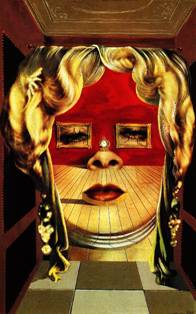
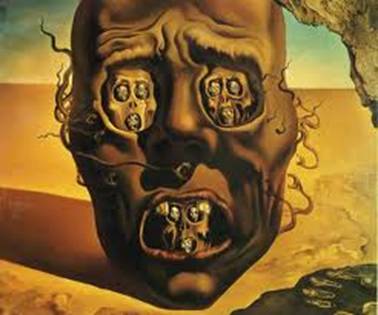
Dalí's works: Mae West's Face (1935) & The Face of War (1940)
In his creative work, Dalí frequently invokes Freud, the psychology genius of his era, and also makes effective use of his insights to characterise his characters, for "automatic actions always prophetically and unhesitatingly reveal our thoughts, the secrets of our soul."
"Such is man! A rigid backbone, passionate in love, in fear of death, far from bloody forebodings, his face hidden and forever between heaven and hell in his quest for being!"
The setting of the 1930s and 1940s to some extent evoked a nostalgia for realities and habits that were still familiar to society in the recent past but today are almost entirely forgotten - for example, handwritten letters to which one attached clippings from a newspaper or magazine to tell a friend about some event.
A few more quotations from the novel that spoke to me:
"Terms are not imposed on the vanquished - brought to their knees, yet capable of remaining on the same level as the victor."
".. the happy always live in the middle, just as the damned do: heaven as much as hell is always at the very centre."
".. one should never discuss that which belongs to oneself alone ..."
"I have always dreamed of a house where all the door handles would be of such dull and oxidised solid gold that it would never even occur to anyone. From passion arrested only by oxidised sterility: that is luxury!"

comments