Information Quality and Speed
The less time given for risk assessment, the greater the risk. But also the greater the gain. If you go by the principle: "Free cheese... only for the second mouse", then in an age when information exchange and processing is measured in milli and nanoseconds, the second mouse may get nothing at all - or secure traps await it, because the first mouse will have calculated the possible risks and moved on to another piece of cheese...
Information - previously unknown data about some object, concept, event, or something else that is the object of certain operations that have substantive interpretation. In this case, the operations include perception, transmission, transformation, storage, and use. Information, unlike data, has meaning.
From the perspective of acquiring information, the source of information, its reliability, and the way it is interpreted are important. From the perspective of further use or application of information, what matters is the comprehensibility of the information to the subject who will subsequently make a decision on the basis of that information.
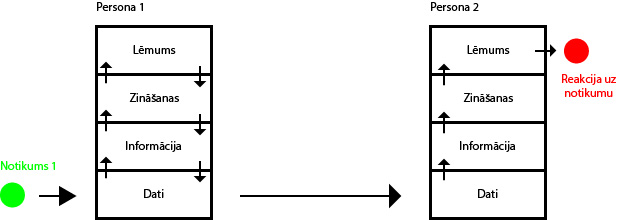
Figure 1. Information Exchange
Message Length
The most common format for transmitting messages is language. An interesting fact emerged from analysing the US/Japan war [1]. It was found that one of the reasons that helped the US win is the comparatively short length of military command words. Compared with the Japanese language, where the average command word length is 10.8 characters, for Americans it is only 5.2 - which is 56% shorter.
Russian is no less interesting. The length of command words "in normal conditions" is 7.2 characters, but in critical situations this can shrink to 3.2 characters by making use of profanity, where a single word, as we know, has several meanings - but in special circumstances the meaning becomes unambiguous :)
Commands can be replaced by auditory or visual signals, on the condition that both parties (the information sender and receiver) understand the context of these commands (e.g. they are in the same environment). But how does one proceed if the context is not unambiguous and the information receiver is several thousand kilometres away?
Information Processing Time
The fastest reaction time for a human is approximately 1 second. This is the time from the occurrence of an event to its being noticed, identified, and acted upon. To pass this information on:
- In a minimum of 3 seconds, one can write a text message or a Twitter tweet.
- In a few seconds - call someone.
- From 1 to 10 minutes - write a Facebook post.
- From 10 minutes to 1 hour - write a story and post it on a news portal.
- Starting from several hours - write a situation analysis.
Only on the following day can an event be covered in a newspaper, and after a week or a month - in a magazine. Undeniably, in print media the information will be of higher quality, most likely checked and edited. But... - post factum.
Information Goals
Information, by its purpose, could be classified by objective criteria - must be responded to immediately or can be deferred - and by subjective criteria - does it affect me or not.
Putting it all together, for example, one can read a politician's statement the next day, because:
- The statement has no immediate consequences,
- The statement can be amended or retracted,
- It does not affect me.
For stock exchange brokers, a company's announcement of a significant improvement or deterioration in its situation activates both objective and subjective criteria: the response must be immediate (buy or sell), the decision made will have consequences, there is competition, and hesitation is not acceptable.
However, despite the trained reaction and ability to quickly assess the situation and knowledge of the field, someone manages to be faster.
The Algorithm Ecosystem
Automated decision-making based on algorithms has long been nothing unusual. For example, when darkness falls, the lighting switches on. However, there are fields and threshold figures that give pause for thought:
- An optical signal from London to New York travels in 65ms;
- The fastest time in which a transaction is executed in the NASDAQ system is between 1ms and 10⁻⁶ s;
- Only 760 nanoseconds are needed to execute a trading transaction for a specially prepared trading system (hardware accelerated trading chips).
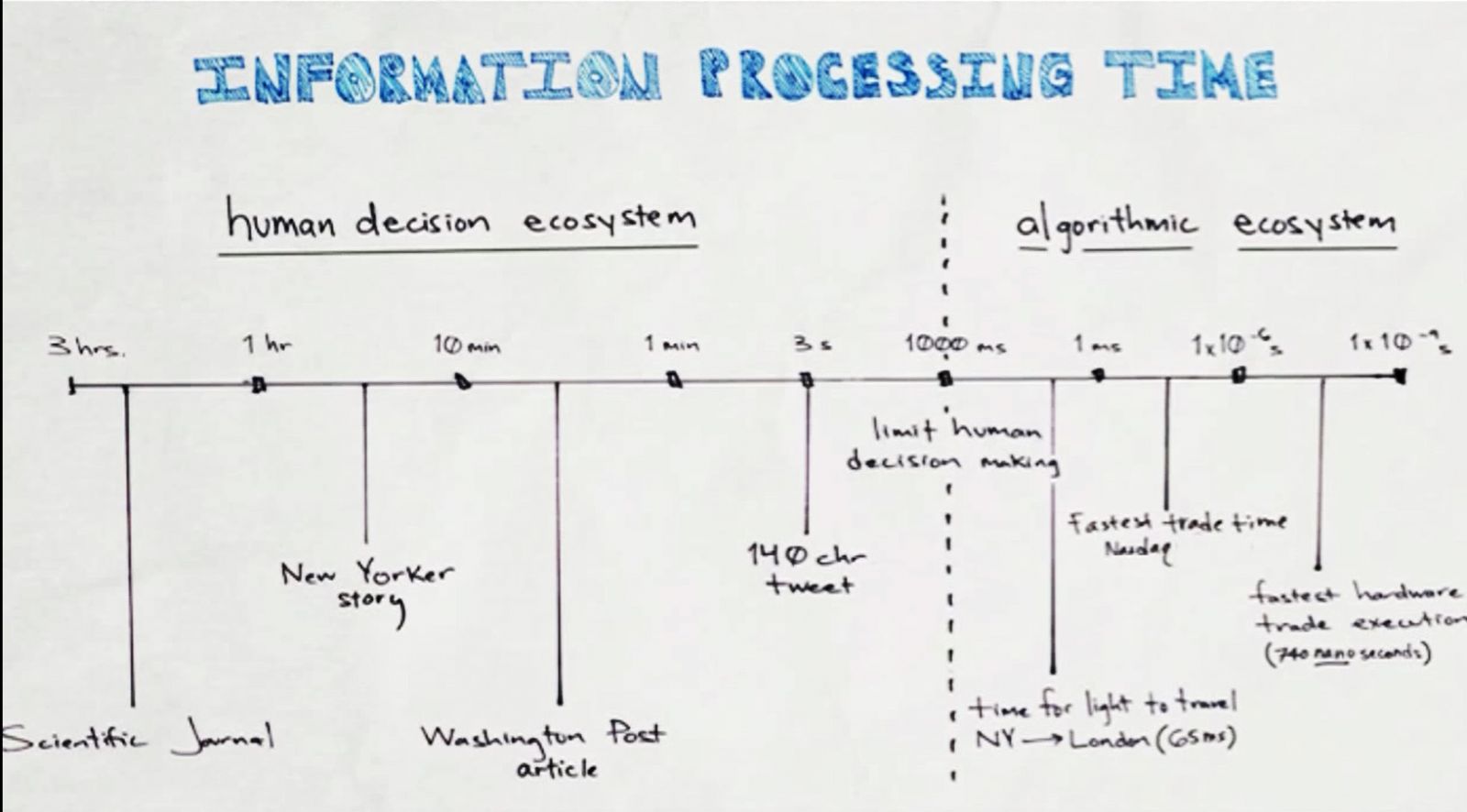
Figure 2. Information Processes
Information and Risks
The less time given for risk assessment, the greater the risk. But also the greater the gain. If you go by the principle: "Free cheese... only for the second mouse", then in an age when information exchange and processing is measured in milli and nanoseconds, the second mouse may get nothing at all - or secure traps await it, because the first mouse will have calculated the possible risks and moved on to another piece of cheese...
TEDxNewWallStreet - Sean Gourley - High frequency trading and the new algorithmic ecosystem
References:
comments