On Presenting the Same News Differently in Latvian and Russian in a News Portal
Latvia is not mono-ethnic, and therefore there exists, albeit theoretical, inter-ethnic tension. Action, in this case from a media outlet's side, aimed at creating different information spaces for different ethnic or language groups of one country's residents, must also be considered a matter of national security.
 Addressed to:
The National Council of Electronic Mass Media
The Social Cohesion Committee of the Saeima of the Republic of Latvia
The Latvian Journalists' Association
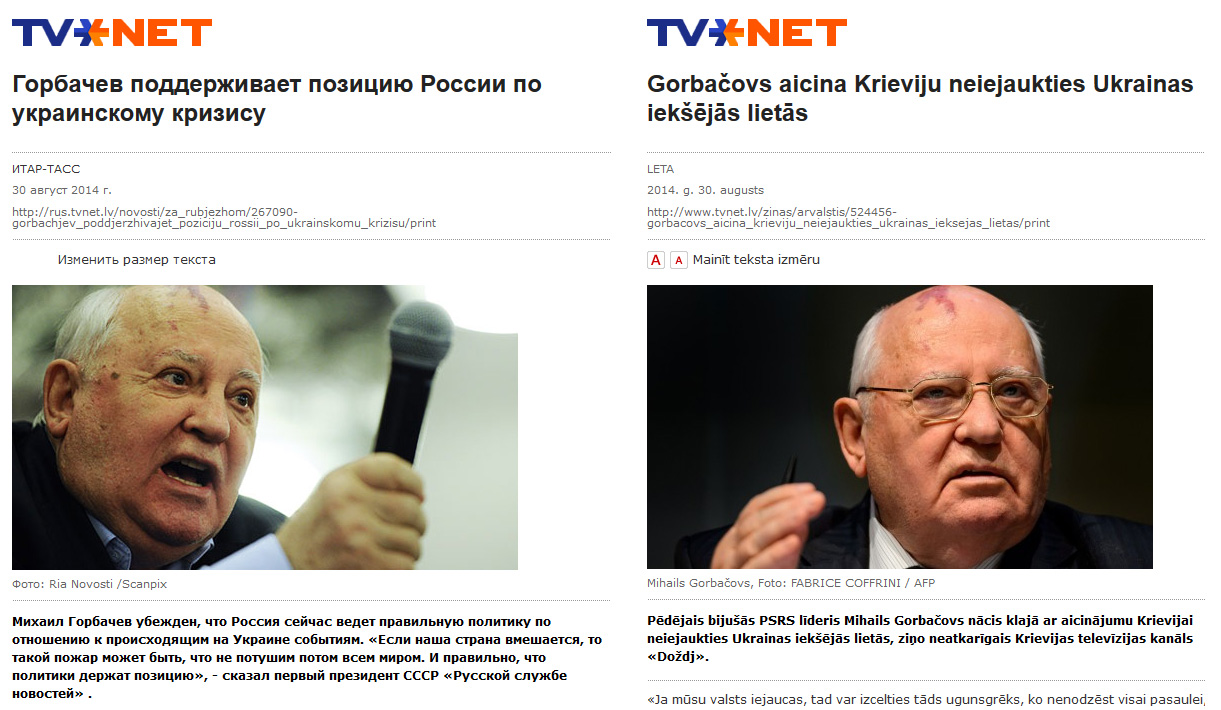
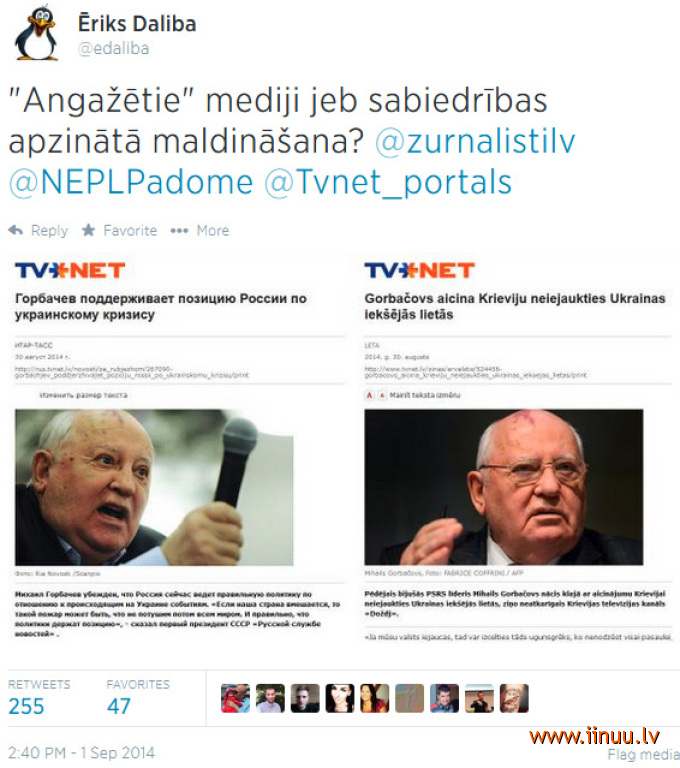
On 1 September 2014, while reading the news portal www.tvnet.lv (hereinafter - the portal), I noticed that the 30 August 2014 news item "Gorbachev calls on Russia not to interfere in Ukraine's internal affairs" (hereinafter - the news item), in the same portal's Russian version, the headline of essentially the same news item is presented in a completely different content and meaning, namely "Горбачев поддерживает позицию России по украинскому кризису" (Gorbachev supports Russia's position on the Ukrainian crisis). The substance of the news item concerns Gorbachev's call for Russia not to interfere in Ukrainian affairs, but the two versions differ in the motivation of the call, and as a result, the reader in Latvian and the reader in Russian may form a diametrically opposite impression of Gorbachev's position.
I consider that such a practice of electronic media, where a news item published by the same media outlet but in different languages differs in its message, is impermissible, is reprehensible and must be stopped for the following reasons:
[1] The events in Ukraine are a particularly significant topic for Latvia's residents, especially for those living near the border with Russia. Particularly given the comparisons that have been voiced more than once in the public domain between the similarity of Latgale to eastern Ukraine.
[2] Although I do not have research on internet media reading habits, empirical observations lead to the conclusion that different information blocks (headline, short description, illustration, article) have different perceptual "weight" and varying frequency of being read, and if the reader has not familiarised themselves with the body of the news item, the headline alone may serve as a sufficient, autonomous unit of information.
[3] A media outlet has the right to choose information sources at its own discretion, but they must reflect the event and the diversity of opinions as comprehensively as possible. In this case, the same media outlet is involved, and there is therefore no basis for assuming the portal did not have access to information from both sources (the Latvian-language item references LETA, the Russian-language item references ITAR-TASS).
[4] The Senate of the Supreme Court of the Republic of Latvia in its judgement of 17 October 2012 in case SKC-637/2012 indicated that the enumeration of mass media in Article 2 of the law "On the Press and Other Mass Media" is not exhaustive and that the said legal norm also applies to those mass media operating in the internet environment and engaged in the collection, preparation and dissemination of information - namely, to electronic communications merchants operating internet portals.
[5] The European Court of Human Rights in its judgement of 10 October 2013 in the case "Delfi v. Estonia" held that an electronic communications merchant is to be considered a co-author of published comments, since it derives profit from the placement of comments and other user activities.
It follows from this that a portal may be interested not only in attracting, editing and disregarding comments, but also in distorting news, presenting it incompletely; selectively selecting those news items and opinions that are more in demand among the audience of a particular language. Deliberately or inadvertently creating an information gap between Latvian and Russian audiences.
[6] According to the Population Register published by the Office of Citizenship and Migration Affairs on 27 August 2014, it is known that 582,000 Russians live in Latvia, of whom 181,000 are non-citizens.
From this one must conclude that Latvia is not mono-ethnic, and therefore there exists, albeit theoretical, inter-ethnic tension. It is known that residents who mostly speak Latvian at home have a different assessment of political events in Russia than those who speak Russian at home, since Russia is often linked to them by remaining relatives, ethnic homeland or the language of their upbringing. Accordingly, action, in this case from a media outlet's side, aimed at creating different information spaces for different ethnic or language groups of one country's residents, must also be considered a matter of national security.
References and links:
1. http://www.tvnet.lv/zinas/arvalstis/524456-gorbacovs_aicina_krieviju_neiejaukties_ukrainas_ieksejas_lietas
2. http://rus.tvnet.lv/novosti/za_rubjezhom/267090-gorbachjev_poddjerzhivajet_poziciju_rossii_po_ukrainskomu_krizisu
Examples where the headline and/or content differs between languages:
http://www.curika.lv/blogs/2014/9/2/tvnet-latvieu-un-krievu-valodas-versijas-izraisa-neirozi
comments