Open Class at the Alegria Exotic Dance Centre
On Thursday evening, 10 August, I attended the open class at the exotic dance centre Alegria, held at 4 E. Birznieks-Upīša Street, in the hall of the Young Technicians' Centre. Centre director Ilze Zariņa introduced four dance styles that can be learned from Alegria's teachers - belly dancing, Indian dance, flamenco, and Gypsy dance. To illustrate each dance style, there were teachers' performances (see video).
On Thursday evening, 10 August, I attended the exotic dance centre Alegria open class, held at 4 E. Birznieks-Upīša Street, in the hall of the Young Technicians' Centre. Centre director Ilze Zariņa introduced four dance styles that can be learned from Alegria's teachers - belly dancing, Indian dance, flamenco, and Gypsy dance. To illustrate each dance style, there were teachers' performances.
Despite the announcement published in the newspaper Diena (which was precisely what drew me) and the information on the website, there were relatively few people interested in starting to learn one of the dances. As far as one could gather, the main audience consisted of existing dancers (regrettably, only of the female sex, as men in Latvia are slow to take up dancing), teachers, and a couple of curious onlookers.
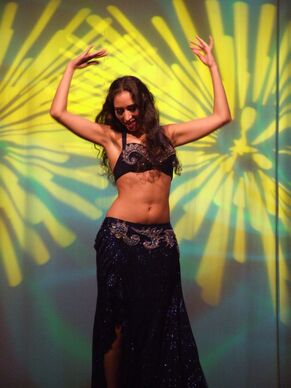
Belly dancing. At its foundation is the ancient Egyptian fertility ritual dance, supplemented and modernised over the centuries. Belly dancing is particularly recommended for women - it tones and relaxes the abdominal muscles, strengthens the functioning of the reproductive organs, improves blood circulation, makes the spine more supple and flexible, and slows the ageing process. By its nature feminine, sinuous, elegant, and life-affirming. In a sense, it is dance as therapy. To begin learning belly dancing, the main requirement is the desire to feel and unlock femininity within oneself, and the wish to move to Eastern (Egyptian, Lebanese, Moroccan, Turkish) music or the rhythm of a drum.
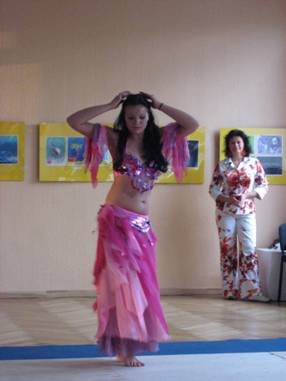
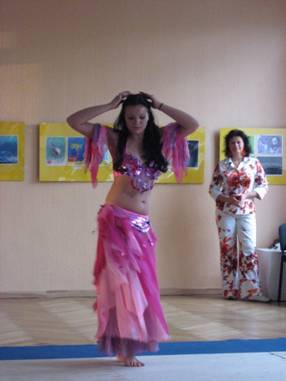
Teacher Ieva, who has been dancing actively for 4 years and teaches beginners as well as younger girls, performed two belly dances - one calmer and more graceful, the other a drum solo.
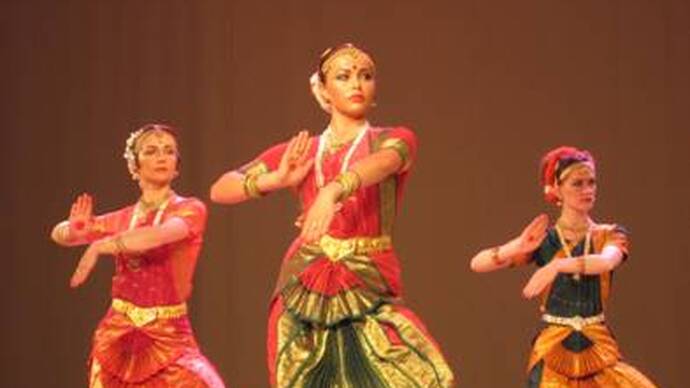
Indian dance. "Bharata Natyam" - a refined and complex form of South Indian dance art (Tamil Nadu state). According to legend, its first performer was the god Shiva himself. He taught it to his divine wife, and she passed this art on to humanity.
It is a rhythmic and dynamic dance, characterised by a variety of movements with an emphasis on jumps, turns, and rhythm. "Bharata Natyam" is called the rhythmic aspect of yoga. The finger positions in this dance are always firmly fixed in "mudra" positions, which follow one after another depending on the dance figure or narrative. The unique system of hand positions is described in the most important ancient texts dedicated to the performing arts, and this system forms the "alphabet" of all dance schools. The basic positions are balanced poses with outstretched arms, which lend the dance its linearity. "Bharata Natyam" simultaneously possesses strength and beauty, slowness and speed, purely technical elements and mime. The style suits both solo and group performance.
The classical Indian dance uses the body as a means of communing with God, or as an instrument for transforming oneself and the world. Until the beginning of the 20th century, this dance was a component of temple ceremonies. The dancer, her guru, and her musicians were greatly respected and lived under the patronage of the temple. The dance itself, aside from the elaborate ritual ceremony, was also performed on other occasions and at appropriate times - for example, at a festival, a coronation, a wedding, the birth of a son, or when moving to a new city or home.
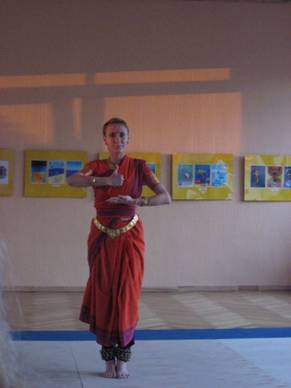
Dance teacher Janina demonstrated both the Indian dance itself and also the 28 unique finger positions, which can not only be shown but also sung. She explained how important the narrative and the symbolic meaning of each gesture are in Indian dance. To choose to learn Indian dance, one needs strong motivation, as not only the movement vocabulary but an entire philosophy must be mastered.
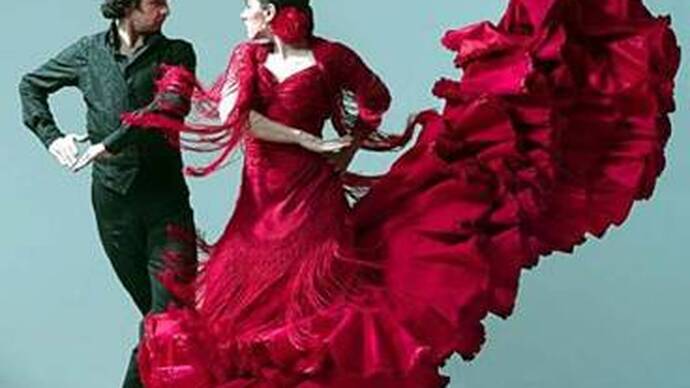
Flamenco. Its place of origin - the southern Spanish province - the land of Andalusia, where it was danced by the Romani. It developed as a synthesis of the cultures of the Romani who journeyed from India, of Muslims, Moors, and Spaniards. Rhythmically this dance is complex and unfamiliar. It demands emotional and spiritual maturity. Likewise the combinations of foot and hand movements are initially difficult to master. But for those who have once seen genuine flamenco and heard the fiery Spanish music, it cannot be forgotten. This dance develops one's sense of rhythm and the straight back of raised arms. By its nature rhythmic, complex, proud, defiant, and tragic.
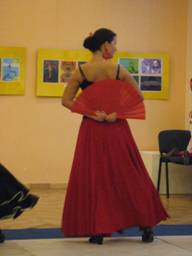
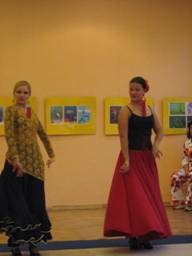
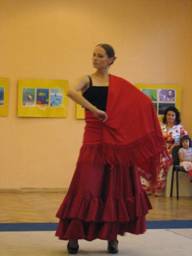
I must say that this is the dance - the one for which I came to this open class. The femininity and sinuousness of belly dancing I had encountered a couple of years ago from the talented Madona teacher Dana, but I have always felt that something fiercer and more self-proud was calling to me. After several wonderful dance performances given by the school's best dancers and by teacher Ilze, who teaches more experienced dancers, I got to know Santa, who gives courses for beginners. To come and dance, one needs shoes with a 4–8 cm heel (already appealing) and comfortable clothing - trousers or fuller skirts, and of course the commitment to learn. I'm not yet sure that anything will come of it, but it will have to be tried.
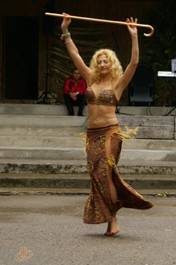
Gypsy dance. It is temperament, freedom, passion, and soul. These dances contain much improvisation and feeling, an ever-intensifying rhythm, and vibrating movements. This dance is very vital and suits women of all ages, as long as they have the capacity to feel genuine joy and genuine sadness. According to an ancient legend, all Romani people were once birds. One day, flying above the earth, they saw a wondrous palace gleaming in the sun. Driven by longing, the Romani birds flew into the palace, which was filled with geese, hens, and turkeys. These were struck by the beauty of the visitors and began tempting the colourful birds with gifts, gold, and precious stones - just so the Romani would stay in the palace. Soon all the Romani were dressed in shining gold. Only one bird resisted the temptation and did not touch the gold. It called on all to fly away, but no one listened. With a heavy heart, the bird rose into the sky and plunged to the ground like a stone. Its death brought the Romani to their senses. They tried to take to their wings, but the gold had made them too heavy. The hens, geese, and turkeys triumphed; they wanted to keep the Romani in gilded cages. But from the sky flew down a small, red feather. It freed the Romani from the weight of their possessions, but could no longer lift them on wings. The feather rose on the wind and flew off along the wide roads of the world. The Romani followed it, and fluttering their wings restlessly, the birds transformed into people. Only their souls remained the same - they belonged to birds who had forgotten how to fly.
A performance by Gypsy dance teacher Signe.
Materials used from www.alegria.lv
.jpg?w=690&mode=16x9|crop)
comments